Mzungu, Bye-bye

11.3.18

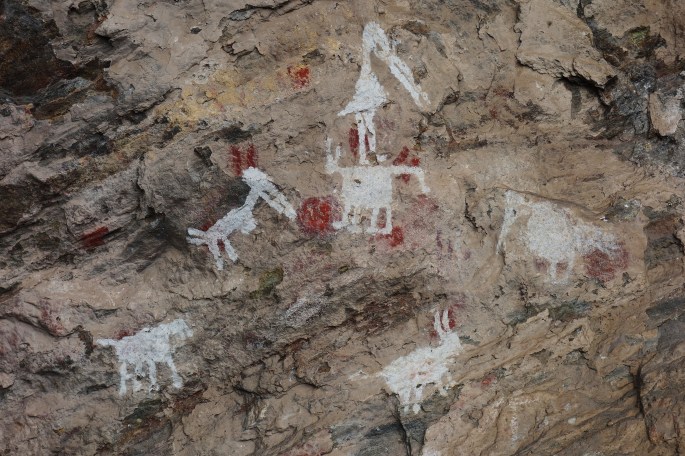
[Above photo: San (Bushman) paintings in the Chongoni Rock Art Area of Malawi: >2000 years old]

After the excitement of the prior week’s break-in and battery of our friends, Linda’s hectic and ambitious schedule, and the conclusion of another 6 week medical student rotation, we were ready for a break. And we took one, spending two nights with our friends, Peter and Caroline, at the Dedza Pottery Lodge. We hiked Dedza Mountain one day, getting a total drenching for an hour on the return. It was a 9 ½  mile hike with about 2200ft elevation. We thought we had done it last year; the same guide took us about ½ way up. Linda asked why he didn’t take us all the way on that trip. “You were tired.” We probably thought we’d arrived at the top and were tired. It was a really beautiful hike up the mountain and across the top through flowered fields and past thick woods.

Today we hiked up to one of the San rock art sites—Namzeze—and saw ancient geometric drawings and paintings of animals. They were in a tall but shallow cave, far up a hill, where the artists lived with their hunting and gathering families. It is wonderful to imagine them there, well protected, as they were high over the valley and could see anyone approaching. Apparently, they were a very small people; the Bradt Guidebook says that they would ask a Chewa or other normal-sized person if they had seen them approaching. If the other said, “No, you are too small.” the San would instantly launch a poison dart into them. Talk about a Napoleon Complex!

On our return to the car Linda paused at a house where a number of people were cleaning and bagging their potato crop. “How much is a bag (huge, 50kg)?” “15,000 kwatcha ($20).” We said it was too many potatoes.  “7,000 (less than $10) ?” We felt guilty and gave them 10,000MWK if they would carry them 1km to our car which we had parked before hiking across the badly damaged bridge. [We actually gave them another 2000MWK just for good measure.] We split them with Peter and Caroline and now have 50+# of potatoes, most of which we’ll give to our 3 guards. As we drove the several kilometers back to the Pottery Lodge, children would stand by the road and shout, “Mzungu, bye-bye!” Mzungu is the plural of ‘White European’ (azungu).

I finished The Essex Serpent, which is beautifully written and portrays characters and their choices in a way that struck me as true. The ambivalence of all relationships, the painful struggle for truth and honesty in relationships which often bumps up against kindness and chemistry, and our fundamentally irrational natures which leave us easy prey to mob-think. It seems pretty apropos for this moment in the US.

Now I’m on to Dark Star Safari, Paul Theroux’s account of his trip overland—often by the most difficult routes—from Cairo to Cape Town. He has spent a lot of time in Africa; he basically got the Peace Corps thrown out of Malawi for writing unflattering things about the government when he was here as a PC volunteer. He certainly has a gift of description and a knack for finding adventure and interesting people. He also is pretty cynical and speaks from a superior and elevated position that I find unpleasant much of the time. However, I am drawn to it in anticipation of our planned trips to Mozambique in a few weeks and to Zambia-Botswana-Namibia in July and August. He is a pretty adaptable and intrepid traveler, I must admit.

We have seen the most incredible sunsets here, as I’ve often commented. I’m not sure what the atmospherics are that enable them, but the colors and the cloud formations are the stuff of fantasy. We passed a rainstorm on the drive home and there was a striking rainbow. In the 15 seconds it took me to find and ready my camera for a shot, it vanished. I recall  concerts at the Filmore in the ‘60’s when they’d pour different colored oils on a glass plate, or between two glass plates, and project it onto a screen. That plus the music plus some herbal encouragement and it was pretty outrageous. With no electronics and no music and certainly no intoxicants, sunsets here are even more breathtaking!

It was fascinating and exhausting to conduct 8 hours of oral examinations for our 27 students on Thursday. Some were just outstanding and two girls, who seemed in clinic and elsewhere to do creditably, came up short. They didn’t correctly identify Delirium Tremens from a very simple and clear anecdote and when we gave them the diagnosis, they didn’t know the correct treatment. It’s serious business, as it is likely the most common form of delirium they’ll see and untreated it has a 20% mortality rate. So they’ll repeat the rotation next year.  One was pretty much a cipher during the rotation, the other seemed like she was learning very well. I’m not sure what happened but often we learn that they are scrambling for their school fees or someone important has died and they are unable to concentrate on their work

At the Feedback Session on Friday, one of the girls who flunked was present, which was brave.  Those who have gotten a call the night before rarely show for the feedback. Fortuitously, the student sitting behind her in the auditorium had just completed the rotation for a second time and, standing, made an eloquent statement about how upset he had been to flunk and how glad he was that he has repeated it. “We sometimes just try to pass through this or that course, to get by. But this is now inside of me and I’ll remember what I learned whenever I see a patient.” It was just the ticket.

The students noted that they felt heard and understood by us. They were very appreciative, which always feels nice. One student criticized Stefan for being so short and angry one day in clinic. He’s gotten the identical message at other times from students. I could, and should, let him know the same; he gets too scattered and, then, rude and abrupt.  He has been under a lot of stress from all sides recently. He’s putting on a major research conference in Lilongwe this week for graduate students and faculty from all over Africa and many from UK.  He’s let me know some of the difficulties he’s had getting very simple, basic things done in preparation, so I feel sympathy for him.  After this week, his life should be much easier.

I’m weary and feel like sinking into our bed. This offering feels less lustrous than any Malawian sunset!

Break-in and Battery

4 March 2018

[Above photo:  I always loved dioramas. Each time we dust we get to rearrange the herd.]

The crash of broken glass awakened them. Then there was a second loud noise, as a crowbar was used to pry open the metal door from the inside, through the broken window. Suddenly there were flashlights, someone saying, “We are searching.” The first thought was, “It’s the police and there is someone in here.” Slowly the realization spreads that these are the “someones”. A home invasion. Six men, complete with clubs and machetes.

It happened to the three Scot psychiatrists, two women and one man. The former two are retired; the latter is younger, tall and muscular. They were kept in their respective bedrooms and made to sit in a corner on the floor. The man kept standing up and would be punched until he sat back down. One of the women, tiny and feisty, stood up and screamed at those rifling through her stuff. Her “guard” hit her in the face with a long plastic rod, giving her a black eye and knocking her to the cement floor, where she landed on her hip. After begging them to leave her passport, they tossed it to her. Laptops, tablets, cell phones, shoes, cooking oil, suitcases, and so forth were all taken. The two guards were tied up outside.

A honking at our gate, for we live 2 blocks from them, at 2:30AM awakened our guard, Catherine, who yelled, “Dr. Stewart, Dr. Stewart.” Linda was in deep sleep, bless her. I jumped up, thinking we’d been invaded and tried to pull on some shorts in a hurry, falling to the floor in my haste. Then a police vehicle with blue lights flashing drove into our yard and discharged the three Scots.

The remaining details are not so important, except that the police attempted to extract a $50 fee from each of them for taking and writing the report. (The standard fee is 5000MWK, about $6.75.) The Scots are settled in a quiet lodge for the week they have left here. We purchased three smart phones for them to use. We fed them last night. We’ll have an outing today with them. They are remarkably resilient. They were staying in the house next to our first one, owned by the College of Medicine. Peace Corps was right; the security there is terrible, despite alarms and some razor wire. There isn’t a strong and secure gate and there are no walls, just chain link fencing. Adil and Anneka were in that house last year, two young female physicians. I’d hate to think of what might have transpired if it had occurred during their occupancy.

It does strike me how things, everything, can change in an instant. A cardiac arrest. A distracted driver hits a bicycle. A home invasion.  Prior to  visiting our friends, Mike and Susan, in Central African Republic in 1972, they were invaded. Their bedroom had an air conditioner, so its noise masked other sound. Something awakened Mike, who saw four men gathering up their possessions. He wisely feigned sleep and all they lost were wallets and electronics.

This past week on two successive days we had two very psychotic, agitated, and violent patients. They required restraint and involuntary parenteral medication: diazepam and haloperidol. They each settled for a bit on a mattress on the floor while the nurses attempted to secure transportation to the mental hospital in Zomba, an hour away. The nurses were told they’d come by at 2PM. No one came either day. Follow-up calls revealed that “There is no petrol” or “The ambulances were all busy.” The problem is that if you plan for a 2PM transport, you can time medication to keep them sedated until they get admitted to the hospital. If they don’t show until 7PM, or not at all as in these instances, the patients are left in the care of their families, becoming agitated and violent again. Or they get up and abscond. The nurses work 8-4 and then the clinic, naturally, closes. The AETC (ED) is not staffed to keep agitated, violent patients, so there is nowhere for them to be. Patching the system so as to provide this very basic level of care, as Stefan is attempting to do, seems nigh impossible. It is pretty frustrating.

Linda is pursuing her Model Midwifery Ward in an exemplary way. Her several years working here previously, in Samoa, and in Congo have allowed her to understand the situation in a way that I am only beginning to grasp. I set up the Pediatric Mental Health Clinic as I would in the US—-get approval, find space, start it, perform the basic bureaucratic rituals and develop forms and procedures. Get the registrars involved. Well, I fear it will all collapse when I leave. I should have spent a lot of time with the nurses in Room 6, seeing if they even wanted to do this, letting them select a champion for it, and then I could have helped with the details. It needs to be theirs if it is to continue. There may yet be enough time to make it sustainable, but I’m not sure. I realize that I am just a blip on the screen here, despite my skills and training. Whereas Linda has worked so closely at every step of the way with her co-faculty, and with all the other stakeholders, that she has a much greater chance of her project continuing.

I saw a 17yo girl who’d made a suicide gesture and was feeling pretty miserable. Her mother died when she was 11yo of severe malaria, her father remarried and the status of stepchildren here is often one of a rejected outsider. I hooked her up with a Registrar for regular therapy but they didn’t make a good connection and she just appeared at my clinic one day two weeks ago, wanting to see me. I spoke with the Registrar, who has some difficulty just listening and not “doing something”.  Four days ago she brought in her father; it is often a challenge to get a father into a psychiatry consulting room here. He was lovely and kind and understanding and we talked about how difficult his wife’s death was for them all, how they hadn’t discussed it together, and how he recognizes how unhappy his daughter is. They decided they would together join her mother’s relatives (yesterday) for the annual clearing and sprucing up around the mum’s tombstone in the cemetery, the first time he has been a part of it.  And she will bring in the step-mother to meet with us sometime soon (I hope).

I can do good work with individual patients and sometimes they will have lasting beneficial results. But with a conservatively estimated 1.2 million children and adolescents in Malawi needing mental health services, training is where my time is best spent. And that is where most of my time is spent. I just wish I knew when I started what I do now.  It’s always the case.

Even though DT didn’t really want the presidency when he was sneaked into it via the Electoral College back door, now he is saying to the Emperor for Life of China that he’d like his job to be permanent, too. His vision of what is of value in life and for humans and what is not is so stunted, self-serving, and ill-informed as to activate my area postrema, the medullary vomit center.  Have we earned this by letting the welfare (jobs, education, health care) of a class of people be ignored? Is it our worship of the dollar and those with vast wealth, allowing them to dictate our lives? We are such a strange species of animal: Too clever, and stupid, by far.  Too cruel.  The mid-terms are a chance to turn things a bit.

Water, water everywhere, nor any drop to drink —Samuel Coleridge “The Rhyme of the Ancient Mariner”

25 February 2018

[Above photo:  A flock of Hammerkops on our wires—no albatrosses here!]

We have gotten soft, too accustomed to the creature comforts.  We’ve not had a serious electrical outage or water shut-off for a year, I think.   The former because we must be on the trunk line for the College of Medicine which is generally spared blackouts.   However, even though we’ve been getting drenched going to and from work, Friday afternoon until Saturday evening we were without water. Well, we have a plastic bucket with 5 gallons sitting in the bathtub and we had two British Burkefeld water filters supposedly with a total of 3 or 4 gallons of drinking water (turns out they were both almost empty). And the geezer (hot water tank) in the attic can supply a certain amount by gravity. And we can always walk, bike, or drive to the grocery store and buy 2 gallon plastic jugs if it is necessary.  I was surprised at our outpouring of whining and complaining. It isn’t like us. A year ago we would have welcomed it as an opportunity to innovate. “Let’s see. What can we use instead of water? Beer? Wine? Nail polish remover? Turpentine?” It doesn’t help that when the water resumes flowing, mud comes out of the tap for several hours. I sense unrelated Continue reading “Water, water everywhere, nor any drop to drink —Samuel Coleridge “The Rhyme of the Ancient Mariner””

I saw the sun (and it opened up my heart)

11 February 2018

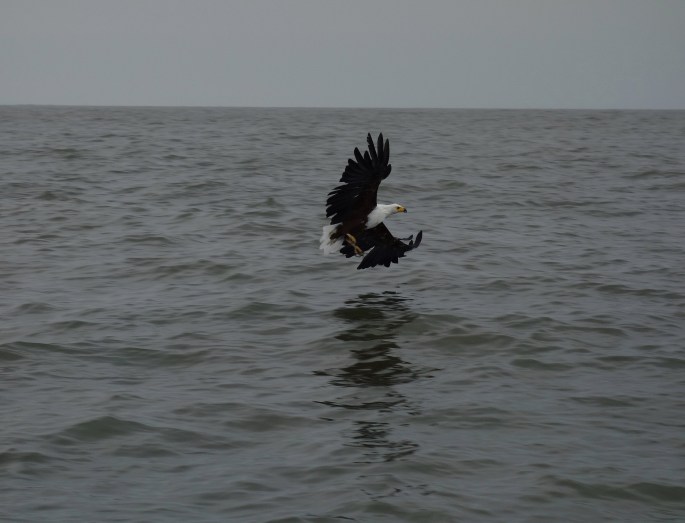
[Above photo:   A sea eagle snatching up a chummed fish.]

In anticipation of our summer trip, I went to the Police Headquarters for the Southern Region of Malawi to get an Interpol document certifying that my car wasn’t stolen. I had a brief moment of anxiety—I didn’t know Patrick or his pedigree when I bought it from him. It was plausible to me, certainly, that he purchased it on the internet, picked it up from Mombasa where it had been shipped from Japan, and drove it to Blantyre, but I had no proof. While at Interpol, I realized how tense I get when in the presence of police here.  Instead of having fleets of cruisers on the roads, they maintain frequent stationary and mobile police stops as a way of having less capital outlay and employing more officers. I always greet them with a smile and a wave, I don’t argue, etc.  Today at a stop one of them said he was hungry and asked if we could help him. I said, truthfully, that we had no food. “Just a few kwatcha?” I replied, “We don’t do that. I’m sorry.” “OK. Have a safe trip.” But “Interpol” suggests spies and international criminals and arrests and warrantless Extraordinary Rendition to a damp, moldy cell in a stone basement in Bulgaria, etc. It didn’t help that the “office” was dirty with broken furniture, papers scattered around, etc. And the “waiting room” had dark, oily spots on the walls where people sat for hours, resting their heads. Which led me to think what does prison look like here? Much, much worse, I am sure. I think that if Mental Health is the tail on the end of the dog of government funding, I am sure that prisons are the very tip of that tail. I was friendly and cheerful and engaging and I got a clean certificate of ownership and left. Around police officers I often find, and it may be my imagination, that I am repeatedly reminded of their power. Like the guard at the front who, when I approached the open automobile gate, shut it before I could walk through, nodding me toward the pedestrian passage. There were no cars coming. He just wanted to assert his authority. And, of course, the less real power people in such a position have, the more they want to exercise what little they can.

The young woman I wrote about last week who I hosptalized returned to clinic this week. She spent 2 days at Zomba Mental Hospital and now was cheerful, calm, and appropriate, confirming (for me) my diagnosis of a personality disorder.  I’ll see how I can be of help to her, although my tolerance for drama is certainly less than it would have been 8 years ago in my office in Berkeley, in part because of the general level of illness acuity here. I know how difficult and time-consuming the treatment of a Borderline Personality Disorder can be, as well, and I don’t feel I have that luxury here. Nor will I ignore or neglect her.  However, I must be realistic about how much I have to offer her and the cold fact that I’ll be gone at the end of June.

I saw a 17yo girl, bright and engaging, who was brought to Room 6 by her mother. Before I saw them I was told of possible diagnoses of Munchhausen by Proxy and Opiate Addiction. Google the former. Basically, a caregiver seeks the attention of medical personnel by inducing illness or forcefully suggesting, repeatedly, that their child is seriously ill and tenaciously pursues extreme treatments for the child. This girl has had 5 surgeries on her abdomen, primarily for symptoms of constipation and abdominal pain. Now she is left with no colon, multiple peritoneal adhesions, and, reportedly, large, disfiguring keloid scars. She wants to study to become a neurosurgeon and is a brilliant-enough student to gain admission to the College of Medicine. And she is taking daily oral and injectable opiates for her pain.  What a travesty! She’d seen an excellent surgeon at QECH, a good friend of ours, who informed the mother that she didn’t need surgery. Her mother, who seems to be a powerhouse, chased down a surgeon at a private hospital and he operated on her. Three times. She had a fourth surgery by his partner and finally flew to Bangalore, India for a fifth. All I said to the mother was, “I hope all of this wasn’t unnecessary.” I’ll see the girl in therapy and try to wean her off narcotics, although it may be a challenge since she’ll likely have anatomically-based pain from her adhesions at times.  Who knows, maybe she had Hirschprung’s Disease where the unlucky patient develops toxic megacolon from having underdeveloped colonic nerve endings.  Or Crohn’s Disease. I’ll try to locate the pathology reports.

In preparation for my medical evaluation for ADD, I got some lab work at one of the private hospitals. It was so strange to be in an attractive healthcare facility with clean walls and floors, nicely kept grounds, and fresh paint. It seemed a bit sterile and safe and I clearly prefer working at crumbling QECH with its crowds of mourners and guardians lying around the courtyards, scores of colorful chitenjes drying on lines and bushes, and a general sense of purposeful confusion. Getting some blood drawn and then having an EKG took several hours as the latter is only done in the ED and it was busy on a Sunday afternoon. I expected it all to be normal but when I looked at the results two days ago I appear to have mild hypothyroidism and the machine read-out of the EKG says I have had a septal infarct. The latter I cannot believe, nor does the Peace Corps physician, and she will have a cardiologist friend in Nairobi review the tracing. I’ll repeat the thyroid function panel at the College of Medicine lab in a couple of months; I’m not intolerant of cold, am not lethargic, and my hair is fine, not coarse. My resting pulse is 65. My mother had mild hypothyroidism as she aged.

The entire experience is interesting to me. I realize how I’ve felt invulnerable since surviving my lung cancer and have enjoyed pushing myself physically since then—up the mountains in Acadia, along the Haute Route, hiking in the Drakensberg and the Cederberg, and our Mulanje trips. I enjoy stretching myself biking around Blantyre which has a few hills.  I know, at a new level, how difficult it is to get sophisticated medical care here. And it makes me aware of the reality of my age; if not frail, I’m not 25yo anymore. I’ll see where this all leads.

We have enjoyed 2 nights at Kumbali Lake Retreat, an off-the-grid collection of [thatched—surprise!] huts set above the lake, each remote and private from the others. It is a really cute place in a wonderful location near Salima, east of Lilongwe where we’ll drive later today in order to have my medical appointment and for Linda to meet with her nursing students tomorrow morning. We putted down the coast in a steel-hulled boat the owner’s husband built and we snapped photos as the staff tossed fish for the Sea Eagles to snatch. I haven’t quite mastered capturing those moments yet, often catching talons only or, in one instance, just the spray after the pick-up. Beautiful birds, however.  Last night was a dramatic sound and light show accompanied by heavy rain. At one point we heard a lot of vocalizing off the coast; I worried a fisherman had gone down in the storm but I learned this morning that they sing and shout a lot when they are returning from a night’s fishing. So would I!

We’ve eaten our meals with a very interesting guy who’s the managing director of a company in UK that consults on health care governance—policy development and implementation—at high levels throughout the developing world, especially in Africa and SE Asia. It is to help government make health care funding transparent, so as to stem the “leakage” into private pockets of external (and internal, by extension) monies.  Greed, corruption, and self-enrichment is rampant, not unlike in our country.  It is so easy to point fingers at corrupt dictators in banana (or “shithole”) republics and so difficult to recognize, and to clean up, the mess at home.

I now have three books going simultaneously. Is this disorganization stemming from Attention Deficit Disorder or simply hunger for variety of experience.  It is time to finish one!

Coasting (in high gear)

4 February 2018
[Above photo: Fishermen heading home, Domwe Island as the backdrop.]
I am getting more efficient and focused in my work. I have created a sort of “formula” for lecturing. I begin with a topic, learning objectives, eliciting from the students their thoughts about the signs and symptoms, differential diagnosis, management, epidemiology, etc. related to the issue at hand, present the bulk of material, and end with 5 or so clinical scenarios we use to discuss what we have learned. It is all very simple and interactive and the students stay engaged.
I’ll apply for a grant to run 3 workshops. One will be for the Room 6 psychiatric nurses and our psychiatric registrars and newly minted psychiatrists to help them develop child and adolescent psychiatry skills. It will be two afternoons, covering child and adolescent development, assessment, diagnosis, and management. Perhaps I’ll include Pediatric registrars in the mix. Then we’ll do a larger one for the psychiatric nurses and clinical officers from the 13 Blantyre District clinics to teach them adult psychiatry. Finally, I’ll teach a reprise of the first workshop for the latter audience. I should be able to manage that easily, in addition to my other workload, before I leave. My concern is that I leave child mental health services here in substantially better shape than I found them (non-existent). It is nice to build something but not of much value if it disappears after you are gone.
I saw a 19yo woman in clinic for the second time three days ago with the medical students. She had been not sleeping, was very talkative, demanding, grandiose, and otherwise appearing hypomanic when I saw her with her aunt and mother two weeks earlier. Her mother has a history of 3 episodes of puerperal psychosis and there are two cousins with mental illness. I thought I had found a mood disorder cluster in her family. The young woman was now feeling normal and sleeping well with the very low dose of medication I had given here; she didn’t progress to full-blown mania. It turns out that the mother also wanted to be seen on this visit. So I had the medical students gather a full history on her. The patient was her last-born and she hadn’t been to hospital since but has been taking medications, antipsychotics, continuously for 19 years. She continues to hear “voices” coming from a “radio”—and there is no radio in the vicinity—telling her to go to the market and beg. They don’t really disturb her, other than making her feel a bit “captive” to them. Otherwise, she socializes well, takes care of her house, eats/sleeps well and has no other complaints. It is curious. We know that puerperal psychosis is much more common in families, and individuals, with a history of mood disorder. In addition, stress can exacerbate schizophrenia so giving birth might do that. Yet she appears too engaging, too intact to really have schizophrenia. Is she even psychotic? It points, more than anything, to the trouble we have with diagnostic nomenclature and, more fundamentally, knowing what in heck is going on in people’s brains.
Speaking of focus, at the ripe old age of 77yo I am getting evaluated for ADHD. I am scattered and always have been. I struggle to listen to conversations if there is more than one going on in a room. I have always had difficulty with beginning projects that I lose interest in before I finish, moving on to the next. In 2nd grade, I was the only child who had to copy a page of a book (I chose a famous abridged version of Shakespeare—why was that?!) every night in an attempt to improve my penmanship (didn’t work). I always have a stack of half-read books by my bedside. And I can be incredibly impulsive. I’ve felt like my daughter’s dog, Oscar, when you say, “Squirrel.” He’d lose all sense of what he was doing, as well as his sense of safety, and immediately try to locate the squirrel. No matter that it was on a telephone wire across a busy street—he would tear off after it. On the other hand, I’ve done well in school, made and kept good friends, and been able to focus well with patients. But, with Linda’s urging, I am getting evaluated and going to give methylphenidate (Ritalin) a try to see if it makes my life easier. My major reluctance, beside not wanting to take or be dependent on medications, is that if it really works, I’ll kick myself for not trying it sooner! Oh, well. Life’s a process.
I feel so much better, overall, when I jog. So I have started jogging to the track at the COM Sports Complex, making 4 circuits, and jogging home. I am ashamed to say my time is 12 minutes per mile! I’m sure that will improve as I do it some more. I haven’t run seriously or regularly since before my lung cancer 10 years ago this April, so I have some training to do.
I finally managed to reach the US Embassy in Myanmar and had an interview with two pleasant women. They seemed very positive about my application. They’ll provide quarters in a “Guest House”. (I may pay for my own quarters elsewhere.) I’ll be training graduated psychiatrists, teaching both Adult and Child/Adolescent Psychiatry, and working with others who want to open an inpatient facility for adolescents. I also may train mental health nurses. My interviewers asked if I would be willing to travel between Mandalay and Yangon and teach at both medical schools. A plane flight is less than 45 minutes air time and I like both cities. I would be willing to, although presumably for periods of time, not alternating days or weeks. There are a few hoops through which to jump, primarily arrangements and contracts to be made with each institution, but it sounds as if I may be in Myanmar in January 2019. It is very exciting for me; I’ve wanted to return to SE Asia since I was first there in 2004, teaching with a group in Vietnam. It takes me further from settling into Maine, as I would like to do, and will put some distance between Linda and myself. She wants to be near her grandchildren and has her own fish to fry in the US, not to mention the very possible Midwifery Ward she is trying to get up and running here at Queens. So she may be in Malawi some, in Myanmar some, and in Bar Harbor-Boston some. I worry about feeling too lonely or deprived but I know I am a good sublimator and can derive a lot of pleasure creating something useful wherever I am. The final word isn’t in but I am optimistic.
I was accepted for a poster presentation, but not for a talk, at the NCD conference at Makerere University in Uganda. It is understandable I wasn’t asked to speak because my talk would be about developing capacity for child and adolescent mental health services here, not research. But it isn’t worth the time and $ to me to go and do a poster session, especially since, in fairly typical fashion for meetings in this part of the world, I was notified of my acceptance 12 days before the conference. I am seeing if one of our GHSPers in Kampala is going to the conference and can print and put up a poster I electronically send to them. If not, so be it. I have submitted an abstract of a talk as part of a panel on the same topic for the American Academy of Child and Adolescent Psychiatry annual meeting in Seattle next October. It would have been fun to do it in Kampala, though. And to see the mountain gorillas in Ruanda.
This is very uncontrived and simply flows from my brain through my fingers today. I have no idea if it is of interest or well-conceived/written. When I feel that way, I remind myself that my blog was started as a diary so I’d have a written record of my time here. That relieves pressure I might feel to craft it more carefully.

Down Comes the Rain

28 January 2018

[Above photo:  The view from our platform on Domwe Island. ]

It sounds like the gods are having a serious bowling tournament this afternoon. No ground lightening but continuous thunder in heavy clouds such as I’ve never heard. Now the losers are weeping, heavily. The rains have been intermittent and light this year and some areas, such as Mangochi, have had very little. Everyone gets very worried as the crops won’t grow and there is a strong possibility of famine. So this is perfect, a really heavy rain, hopefully opening a serious season of the same, even if delayed. Being dependent on the weather for your family’s life and livelihood is something from which most Americans are insulated. Oh, a freeze on the tomatoes or oranges is serious but a draught for an entire country without irrigation, which finds it hard to feed itself in a good year, is devastating.

I was called to see a young woman in the AETC (Accident and Emergency Treatment Center) today (Sunday). Since she is a student, we provide those services. 4 visits to the AETC in 4 days for emotional reasons (after a seizure, because she insisted, because she was mute, and because she became violent, respectively) demanded a good evaluation. She has “seizures” which began when she was 14yo, although she isn’t compliant taking medication, never is incontinent, doesn’t bite her tongue, and has never hurt herself when she falls down.  She has a history of sexual molestation. And as I sat with her she was very gamey, variously getting up angrily, putting her arm around my shoulder seductively, talking in circles with a bemused smile on her face, and so forth. Sensing my irritation, I realized she likely has a conversion disorder with pseudo seizures, although she may just be malingering, and an underlying borderline personality disorder. She wasn’t psychotic, although she was certainly appearing “mad”, as they say here. Since I couldn’t get a thorough history from her and I felt she was quite possibly lying to me, I couldn’t feel assured of her safety and sent her to the mental hospital, notifying my colleague there that she’d be coming. I never feel angry with someone who is actually psychotic—whether with a delirium, schizophrenia, bipolar disorder or whatever. So paying attention to what we feel when interviewing patients, as we impress upon the medical students again and again, is crucial.

I never imagined that I could eat enough mangos that I wouldn’t want another. Or that the thought of them could make me feel mildly nauseous. There are so many and my impulse control so poor that I’ve arrived at that destination—-the house of too many mangos! Still, Linda makes jams and chutneys and purees and naturally carbonated drinks from them, all of which are delicious.  She makes the Energizer Bunny look like a slug, and that isn’t just 77yo talking. We’ll go out for a run later; she’s up to 3 miles, I’m just starting at 1 mile.  She’s trying to enter the NY Marathon for next year; I’m trying not to (and I’m winning!).

Here is a 12yo boy who has autism. He ran in front of a car when he was 5yo and sustained a coma-inducing head injury. So he’s now learning disabled, as well. He won’t poop in the toilet; but he will poop next to it. So his mom goes along with that. At least it isn’t in the living room or kitchen. He is her only child. Her husband left for South Africa years ago and has a new family there, sending no remittances home, which is an all-too-familiar story in Malawi. I want to see them every few months, as she seems to find talking about her struggles helpful.

It is so clear in teaching how 3 hour-long lectures in the AM and 3 in the PM is a no-win. Nothing remembered, people falling asleep. How the devil did I manage it, along with all of the medical students of my generation?  No group role plays, no problem-based exercises or interactive lectures. Just a lot of slides and facts to remember. We did learn a lot but our teaching now seems much more efficient and fun. We know children learn better with modestly heightened affect—I suspect we do, too.

We are lining up friends and family to travel with us for parts of the summer trip and have the first few weeks (to S. Luangwa Game Park in Zambia and Victoria Falls) booked.  Long-time friends of Linda’s from UK will do the first leg. Linda’s sister, Donna, who is a great traveler and has spent the last 5 months (?) on an ashram in Kerala will join us for some time early in the trip. Linda’s son in Poland, Jordan, will re-visit us, either in Malawi before we leave or on the trip. He, too, is a consummate traveler, taking short trips from Warsaw to points all over Europe.

Ah, we went to Burns (Robbie) Night again. Toasted the Queen and the haggis, worked up a sweat doing Scottish country dancing. There was a bottle of Famous Grouse at each table—I hope someone who left later than we did took it home, since we only worked our way through 1/3 of it. The Roast wasn’t as hilarious this year but we laughed at our general ineptitude at the complexity of the dance footwork. Sometimes it looked like the randomly moving molecules in a liquid on the dance floor: Brownian movement. Chaos theory. With random acts of kindness in view everywhere.

My Fulbright call from Yangon hasn’t worked x2 last week. Tomorrow AM I’ll await their call and if it doesn’t come, I’ll try to call the Embassy land line with Skype. I am dying to know whether I’ll get it or not. I just am not eager to be posted to the Military Medical School—all men, all career soldiers. Although they, perhaps, need to learn to compassionately and intelligently listen to teens and children more than at the civilian medical schools. I don’t know.  My assignment does pose problems if my focus expands to include the political situation in the country.

We have two great UK psychiatrists helping us for some weeks and a third, whom we know and love from last year, flew in yesterday. We’ll feed them here tonight. It will be fun and lively and the roasted marinara sauce is making me drool. We won’t eat for 3 hours. But the sun is now shining and the world looks sparklingly new.  Time for a jog.

Creative Feats (Feast?)

21 January 2018

[Above photo: As evening descends over the Misuku Hills]

We are hav.ing a dinner party tomorrow (Monday) night. For 11. Linda has to teach until 5PM and will be observed from 4:30-5 by the CEO of Seed Global Health (Dr. Vanessa Kerry), our country Medical Director (Dr. Bridget Malewezi), and a major donor who is looking at the GHSP program in Malawi. And it is the inaugural day for her fundamental math/English cum jewelry-making class in our back yard. She has hired two artists to teach our female guard and 19 other ladies of no formal education and little earning capacity. It will be 2.5 hours, 2x/week for 2 months. It has the potential to be a life-changing experience for each of the women and I am so proud of her for pulling it together.

We cruised all over the immense Limbe market yesterday, seeking colored nylon yarn for bracelets. What a scene that place is! We headed down a muddy path between many, many tiny stalls, loud music and shouting everywhere, colorful chitenje cloth on display, and there was a drunken man having a loud, angry argument with a man who sells, among other things, empty glass bottles. The stall keeper kept his cool but didn’t give an inch as the other man would pick up one bottle after another and smash it into those on display, breaking all. I expected some bloodshed but somehow they avoided that and kept their honor intact, sort of. Much larger and rougher than the Blantyre market.We finally found the yarn and emerged from the market feeling exhausted and all our senses (except touch) assaulted.

Linda volunteered to do the meal. She likes to do that sort of thing. But we discovered that in the crowd were two recovered alcoholics, a vegan, a vegetarian, and someone who eats no gluten, dairy, or pine nuts. Pine nuts we can get past, as we can’t get them here anyway. So she has spent two days assembling ingredients with amazing cheer and creativity: gnocchi made from potatoes and millet flour, cashew butter instead of sweet cream butter, garlic-mushroom cream sauce for the gnocchi using coconut cream, and so forth. I’m only sous chef and grill chef, marinating and grilling the fillet du boeuf and the pork ribs, peeling 5 heads of garlic (and Malawi garlic has the tiniest, if very pungent, cloves), etc.

Anyway, all dishes except the salad, including dessert, are prepared, Linda assures me. But I thought that is why God invented time—so everything didn’t happen simultaneously. We’ll have a great feast and let the Donor know what good work we are doing.

On another note, when I arrived at the College of Medicine a year and a half ago, of the 23 ceiling and sconce lamps to light the ground floor hallway in our building (Microbiology. Hm, is mental illness infectious?) 7 were lit.  Last June before I left for holiday in the US, 5 were lit. Last week, one was lit. Also, both toilets in the men’s bathroom are fried. The communal urinal works but what can go wrong with a urinal?  Not a good sign, I think.  Crisis response, rather than regular and periodic maintenance, appears to be the norm here.  It isn’t surprising that there are water shortages when many sinks and toilets in government facilities run constantly.

We are looking forward to Robert Burns Night this Friday, toasting the haggis and Scottish dancing. Never a dull moment. I always look forward to The Roast. Dry, biting Scot humor.

Two psychiatrists (one from Edinburgh) just came to help teach for 4 weeks and brought us supplies I ordered through Amazon UK—a tire gauge, a map of southern Africa, and a tour guide of Namibia so we can more easily fantasize about dunes and deserts and hikes and sunsets there next winter (July-August).  And keep our tires properly inflated.

I wonder if I am feeling so uninspired writing this because I am feeling so content? As we did our dance of work around each other today, I realized how much I was enjoying sharing domesticity with Linda. It feels more and more natural.

Notes From a Trump-Identified “Shithole Country” — Domwe Island

15 January 2018

[Above photo: The sunset last night rivaled the one described below. To the right is the sun dropping beneath the mountains across the lake, to the left is a squall and shower coming our way.]

We have fallen into Paradise. I doubt we earned it through Good Works. In college I learned that Jonathon Edwards, a famous Connecticut Valley preacher, didn’t think good works saved you from falling through the rotten floor on which you were walking, into the flames of Hell below. Karma is a more convivial view of Fate. In any case, after a 30 minute boat ride we arrived at the only habitation on Domwe Island in Lake Malawi,     1 ½ miles off of Cape Maclear.  The camp is invisible, even with binoculars, from the fishing village of our departure, so well are the structures concealed.

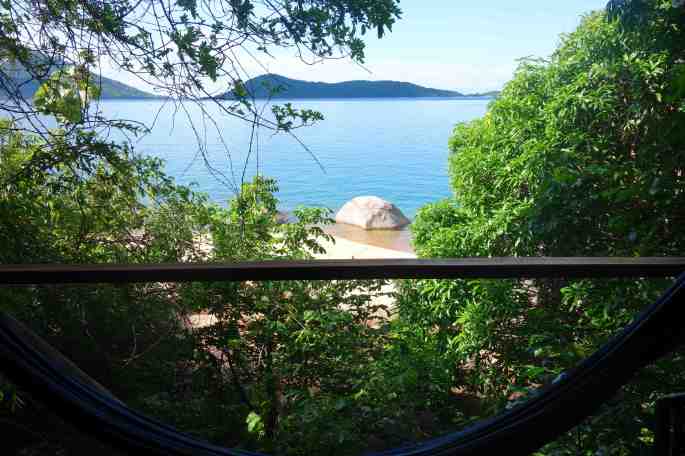
The camp is set on a mountain slope among trees over a beach of brown, granitic sand. It is stretched out and up, so that no structure is visible from another. Everything is built with natural post and beam construction and thatched roofs. There are two 12’x14 feet large tents with sisal mats, double beds, and wrap-around balconies, three or four covered platforms for one’s own tent, a dining “room”, a kitchen, two self-composting toilets and an outdoor shower. Bring your own food and cook it yourself or pay Ashley a pittance and he’ll do it for you. The other staff were gracious and helpful, as well.

Wild bush pigs visit outside the kitchen each night for slops, birds are everywhere, as are water monitor lizards, rainbow skinks, civet cats, and dassie. Our tented platform, with hammock, is at the end of one line, 50 feet over the beach and looking out towards Thumbi Island West, a mile away. At night the lights of fisherman are strung like pearls in the distance, the air is soft and warm, and the only sounds are waves lapping at the beach, a rare disgruntled bird’s chirp, the occasional barking of a baboon, and crickets or cicada.  We haven’t seen a mosquito!

Sunset last night was the most magnificent I have ever seen. Of course, we were on the beach and I left my camera at our tent and didn’t want to miss a minute of the light show to get it. It was like the wedding at the end of a blockbuster Indian Bollywood romance or the Hallelujah Chorus from Beethoven’s Ninth. The sun set across the lake over the Dedza Hills in a blaze of huge dark red rays. Clouds of different formations—-cirrus, cumulus, minimus (tiny, my coinage)—and at different altitudes turned grey to black or white to peach to rose and at the very end there was a show of lightening to the north. It was breathtaking and I’ll have my camera with me on the beach this evening in case there is a repeat. All the while we are watching six gorgeous bee eaters, with green caps and capes, bright yellow bibs, black eye-masks, and pale abdomens, fly a loop, eat an insect or two, and land on the low branches of trees at the beach’s verge.

Yesterday morning we hiked to the top of Domwe Peak for a view of all Creation, then snorkeled along the beach surrounded by a myriad of colorful cichlids. Linda is wary of the water but gamely got into it and snorkeled all around. Today’s snorkeling in the opposite direction led us to fabulous rocks and passages and seemingly limitless numbers and variety of fish.  While lacking the power of a salt-water reef, it was enthralling. After sunset last night we grilled on the beach a filet of beef and eggplant from our garden and ate that with a salad, also from our garden (including the first avocado from our tree), sitting in the dining “room”, watching the afterglow. This morning the fishermen paddled and putted home from their night’s work, some singing, all waving to us. Linda has organized and prepared the food with her customary apparent ease and skill.

We are refreshed after the grit of only 10 days in Blantyre.  And, yet, I like the town and feel pleasure plunging into the noise, color and chaos of the huge public market, to buy a Mother’s Day chitenje with “We Love You, Mum” on it beneath a picture of a woman holding her baby and wielding a machete. I’ll use it to spruce up my Pediatric Mental Health consulting room.

I had an interesting exchange with two of our three Psychiatric Nurses last week. I had previously announced in our clinic meeting that there was up to $4000 in grant money available from Seed Global Health for improving education through the Colleges of Medicine and Nursing in Blantyre. They wondered about it; I quickly said it couldn’t be used for salary or stipend. They then proceeded to say that they weren’t allowed to apply for holiday per diem work or to go to off-campus workshops. Somehow the Health Ministry has allowed some nurses to receive generous per-diem stipends for these workshops. Our nurses’ view is that people think since they have two azungus (Europeans, white people) in the department, we are giving them money so they shouldn’t get the workshop stipends. I assured them that I was a volunteer and couldn’t subsidize their $160/month salaries. (In the US nurses can make $6000 and upwards/month with less responsibility and much better working conditions.) But, I could see about getting a hot plate and electric kettle for Room 6. And I plan to put on a two afternoon workshop, together with tea, samosas, and stipends, to improve their skills at seeing children. I’ll include the two Registrars, although their salaries are so good (from a British educational foundation) that they don’t require a stipend.  It is tough; the nurses work hard. I could afford $20/nurse/month and it would make a difference. But I’ll leave in 6 months and it will set a difficult precedent. There are so many here who need a bit of help.

Linda’s students were doing their routine health education for the women in the post-natal clinic last week. They sang the lesson, as is common, getting the women to clap and sing along. When Linda asked what the Chichewa meant, they said: “If you have a lot of babies, the men will run away. Men are not responsible. Get family planning”. She nearly fell over laughing at their truth.

I cannot say I am laughing as I read Fire and Fury but it is confirmatory, even if a few facts may be interpreted alternatively, of the shallowness, chaos, and mendacity of the DT White House. I know that the “Eastern Establishment” and both coasts have often quietly scorned and disregarded the needs of the poor and working people in our country.  But replacing educated men—Jimmy Carter and Bill Clinton and Barak Obama, whatever their faults, were thoughtful and inclusive—with an impulsive racist who is a multiple-time failed businessman and who cannot, or at least doesn’t, read—really an ignorant man—is about the dumbest, most fanciful act I can imagine.

We await with both anxiety and excitement the news of Linda’s Model Midwifery Ward and my Fulbright application.  Our planning for next year is contingent on both of those. If our health holds, all answers look good to me.  Oh, and the Ugandan conference presentation in February I applied to do. That will just be frosting!

Nyika Plateau, Misuku Hills and Livingstonia

31 December 2017

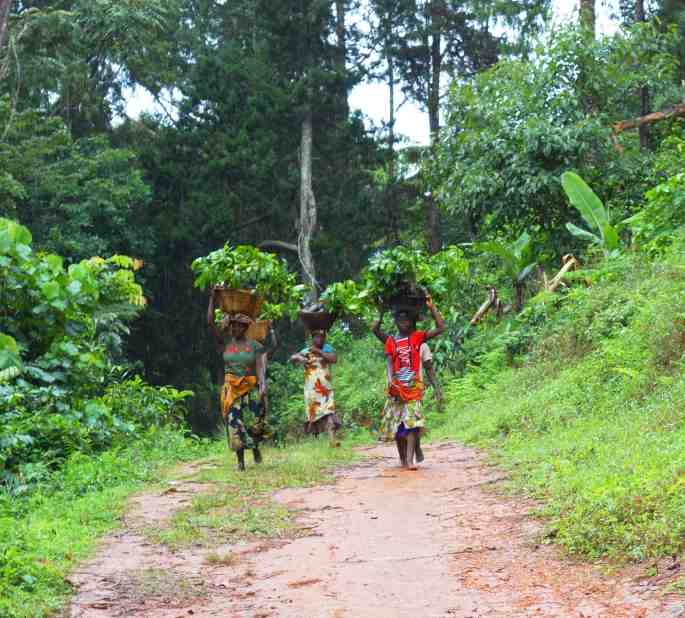
[Above photo:  Women doing the heavy lifting—what’s new?— of transporting coffee seedlings at the Mzuzu Coffee Cooperative in the Misuku hills.]

After leaving Mzuzu, we drove to Rumphi and then on a pretty astoundingly bad flooded clay-slip track for 50km to the entrance to Nyika National Park. The park section of road was generally better; I was very proud of our little X-Trail as it crept up steep, deeply rutted, soaked clay hills without slippage and nearly no scraping bottom.

Nyika is a high (>6000feet) and huge (>3100 square kilometers) plateau in Northern Malawi, a protected area of brachystegia forest, higher rolling grassland hills and collections of pine forests, sometime surrounding small dammed lakes. We pitched our tent in the middle of a sloping field in the campground, cooked supper on a cast iron stove in the keeper’s hut, and slept like logs. The two days we hiked we were treated to herds of eland, of mountain zebra, and of roan antelope, as well as many springbok, reedbok, and the occasional bushbuck.  We didn’t see a leopard, although the prior week one killed a baby zebra near the upmarket Lodge and then was attacked by the adult zebras, running off to climb a tree immediately in front of the lodge dining room as the guests were arriving for breakfast. Talk about a front row seat for the drama!

We hiked long distances and were totally drenched by downpours each day. Linda forgot her slicker, I forgot I had an umbrella in my backpack, and I used my slicker to cover my backpack with cameras, passport, money, etc. We would try to wait out the worst in a copse of pines and then make a break for it. Thankfully, the Chelinda Camp office had limitless free hot tea and a roaring fire so we could dry off after we sloshed in.

We met two couples we liked in the campground. A young Italian learned from his father how to identify porcini mushrooms and found a number of them, teaching us the trick. The next day we found many walking through a pine forest and Linda made a lovely mushroom cream sauce over spaghetti for supper. Since Christmas dinner would have been $40 each and subsequent meals also costly (breakfast-$12, supper-$25), we figured we saved enough for our next adventure by cooking for ourselves.  Sleeping out is fun and we were warm and dry in the tent, despite nightly downpours.

Our last evening it felt like the campground had been invaded by the Huns and Vandals. Two obese and strange men placed their large stand-up tent close to and facing ours, although there were many distant and empty sites from which to choose. One of them, with breasts large enough to excite a teenage boy, silently walked through our camping site wielding a hatchet, stumbled over one of our tent lines, and, turning, said, ”Schram” in a guttural Afrikans.  I didn’t know if he was telling us to get lost or if that was his name.  He and his buddy had appropriated the campfire we’d been using for two days since they’d pitched their tent closer to it than ours was. But the main invasion force was 17 people in 3 truly immense vehicles with cans of petrol and roof tents and towing trailer tents and god knows what else. One of the vehicles was the largest camper I have ever seen; the size of a massive dump truck. The brand was MAN in huge chrome letters across the front. I won’t go on but it was clearly time for us to leave, which we did in the morning. Nyika is gorgeous and seemingly protected for now. The Lodge, which we explored, is a pricey but really lovely retreat with fabulous views of the plateau and a great bar.

We left, slipping on wet clay all the 110km to Rumphi. Then we began the descent to the lakeshore, Linda’s favorite view in Malawi. Although it was rainy and foggy, I could imagine how dramatic and beautiful it would be on a clear day when the lake was visible (When we returned it was clear and we could see everything.).  We spent the night in a rather cheesy but perfectly-situated lodge on the beach south of Karonga and explored the very classy museum in town. Along a time-line were displayed ancient fossils of dinosaurs, proto-humanoid remains, information about the waves of indigenous settlers, and concluded with the slavers and colonists.  There were lots of early artifacts—stone tools, iron spears, bows and arrows, baskets and ceramics. Most interesting in Karonga for me was visiting the house where Linda lived in 1979-81 when she was there in Peace Corps as a Public Health Nurse, riding a motorcycle to various district clinics.. It was a life pivotal experience for her, just out of nursing school, just married, then a new mother, and so forth. And so primitive. No electricity, phone, internet, refrigeration (for the first year). Being a frontier woman at heart, she of course thrived. She is painting a miniature, as I write.

Then off to the Misuku Hills and the Mzuzu Coffee Cooperative guesthouse. The road was a roller coaster, up impossibly high and steep hills, and down the same. After some struggles we drove up the WORST ROAD YET and arrived 5:30pm at the guest house to find it was locked and no one was around. Nor in the manager’s house next door. Walking down the road we asked some boys fixing a motorcycle if they knew where we might find someone associated with the Guesthouse. A sweet boy named Hope said, “Come talk with my mother—she’ll sort it out.” We walked to his home and met a diminutive woman, Mwawi, who spoke perfect English She invited us in and we proceeded to introduce ourselves. She trained as a nurse, then re-trained as a Clinical Officer, then went to Liverpool and did their International MPH program. She started and now runs a clinic, with a new operating theatre, for the farmers in the surrounding area.

While we sat in her house, one of her children, a boy of about 3, came into the living room, dripping wet from his bath, wrapped in a towel. He was very curious about us and wanted to approach us but she firmly told him to get dressed first. As we were leaving, he silently held his thumb outstretched—I reached back with mine and touched his as our eyes met. A transcultural moment of sweetness and trust.

She heard our plight and we all got into her huge, beat-up red Toyota minibus/ambulance, she slid the seat as far forward as she could (She is all of 4’10”!) and drove back down the terrifying road into town to roust out the guesthouse keeper.  I was totally white-knuckling and Linda was speechless as Mwawi drove down and up and down, calling out to friends, neighbors, and patients as we passed their huts.  She made a few enquiries—“He’s not home. I don’t know where he is.”–and drove us back up to the guesthouse. We weren’t sure if we’d cry or wet ourselves, it was so terrifying. Meanwhile the van was making very loud complaints. I thought it was dropping the transmission, which it didn’t.  She wouldn’t accept my offer of money for gasoline. When we returned to the guesthouse, a keeper was there to greet us, opening the guest house and starting a fire for the hot water boiler.

The guesthouse had seen better days but served us well. Early the first morning we heard all sorts of calling and rustling of wings. Looking out the window we saw 15 immense hornbills in the fruit tree behind us, eating, talking, and flying to the next tree and back, no doubt the avian equivalent of the Canadian Air Force Exercises which Harold and I used to do every morning in medical school, listening to the Beatles’ “A Hard Day’s Night”.  The birds were black with a white breast, a white band on the end of their large tail feathers, and a white casque—a sort of bony crown. My field guide suggests it is a trumpeter hornbill, although I didn’t see the “red face”.

We cooked in the kitchen, including a fabulous penne dish of Linda’s (who else?) creation—wild mushrooms from the keeper, Nali (Malawian hot sauce), powdered milk, red wine, and biltong my niece Deirdre put in my stocking last Christmas in Cape Town. Biltong is basically S. African jerky. The result was delicious and we gobbled it down, hunger being a wonderful seasoning.

During the day we hiked on dirt paths over hill and dale with our keeper, visiting a mission school, traipsing through hillside fields and coffee plantations, and even venturing into the higher elevation rain forest reserve. It was drizzly and slippery but all was new and fun. This is the season when large, fat- and protein-filled winged ants come up from below ground. Ant traps are constructed with ingenuity—on a slope a 10’x5’ sort of earthen tub is fashioned, covered with sticks and banana leaves to shut out the light, and a small opening is made at the bottom end, letting in light to which the ants are attracted. A large plastic bucket is sunk in the dirt below the opening and the ants fall into it and cannot escape. They are fried and dried and used as condiments by the locals. And, no, they don’t taste like chicken.  They taste like bacon. I’m dying to try some and shall.

After these adventures, we set off for the lakeshore, heading south, before climbing up the very steep escarpment to Livingstonia, the 3rd and final site of the African Presbyterian Church David Livingston founded. The first two sites were lakeside and everyone died of malaria. This road was, also, a GREAT CHALLENGE, ascending 2200 feet very quickly with 20 extremely tight hairpin turns and large rocks and deep ruts and angled shelves everywhere. I was astounded the car made it—at one point one wheel was in the air, spinning, until I backed up and took a different line. It was worth it, as Lukwe Lodge was tiny, exquisitely designed, off the grid, and the restaurant and our tiny chalet were perched on the cliff, facing across the lake to the mountains of Tanzania. The chalet cost $28/night and the meals were delicious: home-baked bread, vegetables from their garden, etc. Our descent the next morning was easier, though hair-raising.

We spent the final night in our tent on the beach at a backpacker’s lodge in Nkhotakota with one of the couples we met at Nyika (We’ll visit them in Zambia as we cross to Namibia) and drove home in the morning.

There were, of course, many more details.  We were good co-travelers and thoroughly enjoyed each other, even during the drenchings or the hair-raising galimoto (Chichewa for auto) exploits. It was an excellent shake-down for our lengthy foray next summer.

We realized that we are each safe, thoughtful drivers; we each like to be in control and get anxious with the other’s calculus and decisions: a massive 22 wheeler is travelling north at 85km/hour and we are travelling south at 60km/hour. We want to pass the car in front. How many feet do we need to safely pass and avoid becoming roadkill, factoring in the rate of acceleration of our car, etc. You get the point. We’re taking turns driving, is what we’re doing. And trusting in the other.

We both returned feeling refreshed but also liking the freedom of not working. We have 5 months of work left and I know it will pass very quickly once we meet the students and dive into it. I am looking forward to heading to the US next September. At the same time, I wouldn’t trade this for anything!

Mzuzu Christmas 2017

25 December 2017

[Above photo: Our greeting committee as we entered Nyika Plateau—a herd of mountain zebra. ]

We are sitting in Mzuzu Coffee Den with new friends, Steven and Renee, with whom we are staying in Mzuzu. She is a GHSP Mental Health Certified Nurse Specialist teaching at the St. John of God mental health nursing program. Steven is along as support and for fun. Both are previous PC volunteers and both have done considerable international work. They are 20 years my junior and I love their company, as does Linda. We’re already dreaming of joint adventures—the Serengeti, Ngoro-Ngoro Crater, Zanzibar and possibly Mulanje, if PC ever allows us to go up again—and enjoying each other. We’re at the Coffee Den for the electricity and the wi-fi. I dare not drink coffee after my last go two days ago with incredible heartburn. Not for a bit, at least.

We are on a two week holiday, leaving Blantyre three days ago and driving up the incredibly dangerous M-1 to the outskirts of Lilongwe, skirting the terrible city traffic there via side roads, and driving over a 12km dirt track into the Vipya Forest Reserve. We camped at Luwawa Forestry Lodge, plunk in the middle. There is, again, wonderful birdlife, but since I forgot my birding book I am not trying to identify new species so assiduously. The Lodge is a lovely throw-back to an earlier time and there is a dam with a lake, an archery range, kayaks, all manner of whimsical sculptures, endless hiking trails, and a three story treehouse. There even is a huge, friendly (to us—one of the Malawian staff says he has bitten a number of them) mutt named “Bob” whose tail actually is bobbed. He looks like a large, tan Rottweiler and parks himself outside our tent each night, all night. Since there are jackals and hyenas here, it is rather comforting. Our Cape Union tent is a dream—dry, roomy, well vented—albeit at 6 pounds more than I want to backpack. It is wonderful just to be having fun and not thinking about teaching or worrying about patients. Well, I do both but without an imperative, or the ability, to do much about either.

I’ve applied to present about the Pediatric Mental Health Clinic and the Blantyre Child Study Group at a conference on Non-Communicable Diseases at Makerere University in Kampala, Uganda at the end of February. While it isn’t strictly research, I can describe trying to develop Child and Adolescent Psychiatry services here. They are lacking, excepting in S. Africa, throughout sub-Saharan Africa (sSA), so I may get in. If so, Linda will join me and we’ll try to visit the mountain gorillas in Ruanda after the conference. And we want to go to Madagascar and Mozambique on other trips, in addition to our lengthy journey next summer overland to Namibia. Lots of planning.  I am amazed at how much life I’ve managed to tuck into the time since I was discovered to have lung cancer.

We’ll leave here tomorrow morning to head up to Nyika Plateau, to see its beauty and game. We’ll camp there and day-hike. Then north to stay overnight at a coffee plantation—but I’m getting ahead of myself.

We were invited to have supper with Brother Michael (Linda knew him.) and several other St. John of God Brothers last night at their chapter house. First, we had prayers in their tiny chapel, which was decorated with paintings and carvings of pomegranates. “Pomme”—apple—and “granate” from Grenada in Spain where St. John cared for the mentally ill. The Order is in 53 countries, with many hospitals and various charitable good works. Last night we learned a bit about pastoral training, which takes years, requires the students to be fluent in French and English and to learn a new indigenous language every 4 years when they are transferred. Some have trained as nurses, some as social counselors, and one is completing his psychiatry residency in South Africa in another year. There is a lot of rigor to their studies, as well as renunciation. Yet we found them to be fun, funny, engaging, and seemingly having made rational choices to live their lives purposefully to help the less fortunate.

I am a non-believer but cannot help but be touched by the Brothers. And by the singing of the incredible choir at the 7AM Mass at St. Thomas this morning, with drums accompanying. I watch Linda and respect what this means to her even though it is largely foreign to me. I do love the values of giving, educating, trying to relieve suffering, working hard, and helping others to improve their lot. The breadth of Good Works of the Church in Africa is staggering—schools, hospitals, centers of hope and solace, etc. None of the churches we’ve been to are extravagant or gold-filled.

Father Richard, a French-Canadian priest who baptized Linda’s first-born in Karonga 37 years ago, leads a parish here, his 49th year serving in Africa. Linda’s photo of him at the baptism shows a handsome young man with thick hair and a determined demeanor. He still is lively, bright, and engaging at 70, but the years have worn him. He looks pretty tired at times. To be fair, this and Easter are his busiest. We sat in a thatched gazebo and had a soda with him yesterday. A truly lovely guy. If only we humans weren’t so human, with our greed and perversities, inflexibilities and dogma, which have so damaged the image of the Church.

It’s amazing to me that a Semite from the Middle East served as the spark for such an incredible moral movement, especially given our Dear Leader’s penchant for wooing Christian voters and apparent fear/hatred of Middle Easterners (writ large).  DT certainly never pledged consistency.

At this time of year I think a lot about my children, how I miss contact with each, and think about the ways in which I wish I’d been different as a father—as a person, really. It isn’t to beat myself up anymore, just to see what I can learn and not repeat in future relationships. I hope I’ll have a chance to enjoy their company soon.

News Flash: A second Christmas mass this evening lasted 3 hours and was a spectacle rivalling Aida and the horses and camels at the Baths of Caracalla. It was in Chichewa, but mostly in singing, drumming, and dancing. And I don’t mean “Bringng in the Sheep” hymns, as Linda puts it. Amazing harmonies, drumming, and who knows what the lyrics were but the place was rockin’! There even was a baptism, with the infant and parents sitting out the remainder of the service in front of the congregation in a kind of creche. At one point the father stood up and joined in the dancing. It was a joyous celebration, complete with incense. The afterparty, with the Sisters sitting on one side of the rectory common room, the Brothers on the other, and with soda and potato chips in the middle, was not as engaging or joyous, and was reminiscent of the intense awkwardness of 7th grade mixers.  As we were leaving I mentioned to Father Richard that he would find it dull to do mass in the US or Canada. “Ugh”, he said. “No life”. And indeed, after nearly 50 years serving in Africa, he knows how to throw a celebration that really engages Africans (and us mzungus, as well).

[Hm. The power went out just before I was going to post this, so I got a refund on my internet fee!]

A Merry Christmas to all!