Woman finds out her ‘headache’ is really a spider living inside her ear. —San Francisco Chronicle

[Photo: Yet another “brilliant” sunset, Liwonde National Park, Malawi ]

17 June 2017

What passes for “news” these days! I’d rather read the above, however, than listen to Jeff Sessions prevaricate at a Senate hearing or DT attempt to bluster his way out of the scrapes he creates for himself (and us, sadly). And the use of words. I have noticed that Brits here say “Brilliant” a lot in place of “Awesome” or, as Linda tells me I say, “Astounding”. We are trying to amplify things a bit, I suppose, but the opposite happens and the amplifier loses its punch when, for example, we produce the correct change in a fast food joint and the cashier says, “Awesome”. Not really awesome. If we have to suffer exaggeration, I like “brilliant” better—it has a sparkly quality.

I was biking away from Queen Elizabeth Central Hospital (I guess by now I can use QECH and you’ll get it.) yesterday and heard a pitiful voice crying, “Mami, mami”. A young woman leaning on her [aunt’s} arm was crying her heart out. Clearly her mother had died. There is a lot of public grieving of death here, which I am beginning to feel is remarkably healthy. No concern “Is this the proper place to have and express these feelings of loss?” As I biked further I heard the lawn preacher shrieking and roaring out his message to the assembled—from his tone it sounded like Death to All Sinners And That Includes You!—with his cheery background music that sounded like Heidi’s Swiss Accordion Polka.  Then, biking on to Chipiku to buy toilet paper, bread flour, and fillet of beef, I thought about the accident last weekend where an 18 wheel flat-bed semi loaded with tons of sacks of cement lost its brakes on a nearby hill and crushed 8 cars, killing 4, and injuring others before plowing to a stop in a ditch. Why not aim at the ditch at the top of the hill, not the bottom? I suppose we don’t think so clearly in those situations.

Which brings me, strangely, to last weekend in Majete (Wildlife Reserve) with two couples who are friends of Linda from UK. Both men, Chris and Paul, were in the British equivalent of Peace Corps in Malawi in 1979-1981 when they met Linda.  All three have been fast friends since and we, plus two spouses, bonded and laughed over the weekend. We weren’t exactly laughing during the boat ride up the Shire River when we spotted a lot of really large crocodiles on the river banks, slipping quickly into the water—toward us?—as we approached. Well, laughing nervously. Later that day we paused a game drive to have a beer at the river’s edge, admiring the large female croc on the opposite bank through our binoculars. Our guide said, “There’s a rhino.” Sure enough, a black rhino about the size of a Lincoln Town Car (stretch variety) was walking toward us. “Please get into the vehicle” he said with an edge. To our surprise, he didn’t drive away, rather toward the rhino. At one point we and Mr. R were in parallel play on opposite sides of a clump of brush. We turned off the engine and he turned towards us, coming within twenty feet, twisting his head back and forth, aiming his tiny beady eyes, and attempting to see if he should tip over our safari vehicle, attempt to mate with it, eat it, or simply walk off dismissively. Happily, oh so happily for us, he chose the last option. We were all quite scared, not the least because our wild walk across Majete that weekend had been cancelled because there was a rogue elephant.  He/she had killed a ranger, put his/her tusk though a windscreen on another occasion, and, most worrisome, his/her identity was unknown.  So you might come upon a herd of elephants and quietly stopping to watch them note that one was approaching you at 15mph. It was wonderful sighting the rhino, as the guide hadn’t seen one in 5 months.

On one game drive Chris spotted a kudu, lion-killed. He was eviscerated and the liver was gone. We returned the next day and discovered that much more had been eaten. It was likely the lion but it could also have been the spotted hyenas that roam there. Majete has 20 leopards, as well, though they are not easily viewed and wouldn’t compete with a lion.

We occupied the “luxury” chalet, which means our sink, toilet, shower, and sunken bath were all outside facing the water hole, unfenced. Are you sure hyenas don’t drink from the toilet bowl like my dog used to, because I generally get up to pee at night, especially after a Green or two (Carlsberg beer). I’m not really wanting to have to fight my way to the toilet. “Here boy, fetch the stick while I pee in your water bowl.” I must say we had numerous laughs and a few photos of and from the throne. We tried to take an outdoor bath but, forgetting that the water is solar heated and the sun had been down for 3 hours, we immersed ourselves only briefly in the tepid-to-cool water and called it quits.

On our final morning there was an incredible show at the waterhole in front of our chalet and the dining room. I half expected the addition of a cartoon and a newsreel of Allied Forces Sweeping Axis Soldiers Out of France or some such, as well. At 4 AM as dawn crept up, I heard munching outside our window and there was a large, bearded nyala bull close enough to touch. Later it was baboons all around. Then impala and warthogs. Followed by bachelor groups of nyala. A small family of kudu. A herd of zebras with darling babies. Then about 50 Cape buffalo. Each successive group nudged its predecessor off the scene. Enter the elephants. Cape buffalo are huge, fierce creatures but they were very wary and dwarfed by the elephants, especially the immense old bull. He made a rather dramatic entrance through the parking lot, cruising with his elegant stride past where we were sitting. I’d look so silly trying to emulate that walk but it lends him such gravitas that I want to try. It looks like Mr. Natural from the ‘60’s R. Crumb cartoons. The baby elephants were chasing warthogs, practicing their dominance. It was glorious, truly.

How did the wildness of the road lead me to the wildness of a game park? The kudu kill, our near-miss with the crocs and rhinos and rogue elephant, I guess. Somehow the wildness of the wilderness feels more acceptable to me than the wildness of the highways. Animals in the wild are always vigilant, always on high alert status; watching them is a lesson in focus. The sacrifices we make, which Freud and others have noted, to create civilization are the price we pay for predictability and some ability to relax our vigilance. So it seems unfair, having repressed, sublimated, curtailed and otherwise channeled our sexual and aggressive drives, that we should be cut down by a semi loaded with cement and having no brakes.

I’m heading for our island in Maine in 10 days. I’ll be there for 2 months. I can hardly wait. Seeing friends and family.  Sitting on the front porch with coffee and a book as the sun rises, warming me as I look down the meadow toward the harbor. My lobster risotto. I wouldn’t trade my experiences here for the world, yet I do miss home.

A Consultation

[Photo:  Competition in primary care medicine is fierce in Lilongwe and the practitioners have expanded their skill sets.  ]

4 June 2017

I met Chisangalalo Ntonio several months ago and he expressed an interest in my working with his teachers and child care workers. He is the Director of Education for a large (thousands of children served in numerous locations) child care organization in south central Malawi. His father was the first Executive Director of the organization, an NGO funded by a pastor in the UK and his wife. Finally, after a lunch together and several starts and stops on my part because of schedule conflicts, three 3rd year Family Medicine Registrars (Residents) and I met at 8:15AM Friday morning at the entrance gate to the College of Medicine where Chisangalalo was to pick us up. In my experience, getting these consultations going can be a challenge; everyone is stretched too thin. Anyway, by 8:45 I called him; he’d forgotten it was Friday and set out from Lunzu to get us (45-50 minutes away).

Boring details aside, he arrived, apologized and drove us up the Chileka Road through Lunzu, then down a several kilometer dirt track until we reached Aquaids, his organization.  It occupies a large parcel of very rural land, occupied by many buildings—-schools (primary and secondary schools, a school for the developmentally delayed, and so forth), administration buildings, lodgings, kitchens, a methane digester for fuel, etc. Who knew?! And lots and lots of kids.

After a brief meeting with the current Executive Director and a tour of the facilities, I was led into a large hall occupied by 25+ women sitting in a semi-circle facing the front of the room—and me. I didn’t realize that this would be a working visit, thinking it was more of an introduction. So I just winged it.  Seeing the Registrars shake each woman’s hand in turn, I followed suit. Then one of the Registrars said a prayer to open the meeting and we introduced ourselves. Meanwhile I’m scrambling a bit inside myself, thinking how to make this useful to them.

When all turned to me, I asked them to think of the names of a few children about whose behavior they were concerned. Quickly a list of 8 was assembled. We began with one, Jones, an 8yo boy who had pooped in a pot, then cooked it and tried to get younger kids to eat it. He’d also snatched the vice-principal’s solar charger and tossed it into the pit toilet (Ten feet to the surface, then probably another 10 feet of urine and feces to the bottom where it now lies.). And other endearing acts. Was there anything to love about him? Silence. Then, he could be affectionate and if you asked him to perform a task he usually did it very well. Any family history? His parents both died of HIV when he was two and he was raised by his older sister. He is a twin, a runt compared with his twin sister, both of them being HIV positive and taking antiretrovirals. He is still repeating 1st grade, whereas his sister has moved on to 3rd. OK, something to help us understand his behavior, I thought. Bring him on.

In came a tiny, frightened-looking boy. I asked him questions like, What was his favorite food? Rice. His favorite drink? Orange Fanta. I asked him to draw a picture of a boy. He scrawled a circle for a head. I applauded him. I then asked him to take my pen to one of the women in the audience. Which he did and we again applauded him. Fortuitously, someone brought in soft drinks for us all and I requested an orange Fanta for him. He was very pleased and slugged it down in record time. We applauded him again. He was very cute and clearly capable of affectionate, as well as angry, attachment. We thanked him, sent him out to rejoin his friends, and I led a discussion.

What had we seen?  How to explain his naughty, angry acts? The poop soup I dismissed as a variation on children’s scientific researches, sidestepping the hostility involved. So why was he so difficult in class? a teacher asked.  Why do children behave in class? I countered.  They want to please their teacher, for their teacher’s love and approval. As an extension of wanting to earn their parents’ love and approval. But this little boy hadn’t received mother-love, which all the teachers and workers could understand. I spoke of the hint of wild animal I saw in his eyes as he sat with me. Like the impala who is terribly thirsty and comes upon a water hole but is terrified, having previously seen a crocodile emerge from the same to eat his cousin. For Jones, the fear was desperately wanting love and being terrified he’d open himself to it and be wounded, if not consumed.  All of this was pretty simple and straightforward but a voice from outside saying it to a group of overworked, undertrained educators and child care staff seemed to arouse enthusiasm and a sense of recognition. Jones needed a lot of love, especially physical affection, and praise. He might not change rapidly, but those seemed to be necessary ingredients for him to want to behave better and to feel better inside himself. I subsequently realized that it might  be helpful to have one of the workers take him under her wing and let him help her cook meals, since he has a cooking bent. I’ll pass it on.

There was then a closing prayer and we left, driven back to Blantyre by Chisangalalo. On the dirt road from the Center, we passed a few huts. A drunken man, the Village Headman it turned out, hailed us. We stopped, he climbed in the back of the truck as all seats inside were taken, rode about 50 meters and asked to be let out by another cluster of huts. Exercising his power, I guess.

The visit to the center had been a moving experience for me and I instantly fell in love with the place, the children, and the workers and committed to visiting every two weeks. I justify the time to myself, since my task in Malawi is teaching, not providing clinical services, in that I shall be teaching, just not in a degree program like at the College of Medicine. It is so easy to take on too much here.

I leave for the US in 3 ½ weeks and I’m getting excited. The stresses here are cumulative. Water cut-offs for part of the past two days—-didn’t The Water Board know we had a dinner party last night? My bicycle is not shifting worth a damn and needing both front and rear derailleurs to be dissembled and cleaned, which I suppose I can do but don’t want to take the time. Nor do I have the tools, like a seal pick. Once again after payday one of our guards fails to show up, so when he does I must let him know he cannot expect to keep his job behaving like that. And docking him pay for the absent day. I can get most of what I want here most of the time, in terms of books, tools or food. Linda attends to the latter for us very well. However, I often have to travel far and wide to find what I want and often it is to no avail. I need a large mortar and pestle to macerate the paper and leaves we are soaking to make cooking briquettes. I have regularly seen them in the Blantyre Central Market. But not yesterday. In Kamba Market? Nope.  Maybe in the market in Zingwangwe. So I rode there and hiked through the market but no luck. Not sure why I am whining so much. Each little search is fun in its own way. I haven’t shaken my cold yet and I don’t sleep well when stuffed up.  I miss contact with my kids. I miss the relative ease of living in the US. I am longing to sit on the front porch at Beach Island with coffee and a book, as the sun rises and warms me.

We are going to take a walk. Before we go, Linda is making us some chai tea. Maybe my mood, and attitude, will improve.

Drawing a Line

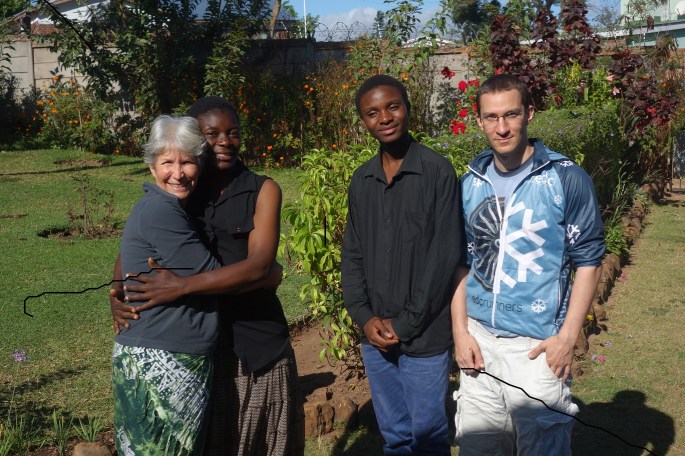
[Photo:   L2R: Linda, Catherine our former guard and housekeeper, Joseph her son who wants to be a doctor and whose tuition etc. we are paying, and Jordan, Linda’s son, an aeronautical engineer visiting from Poland where he lives and works.]

Drawing A Line

21 May 2017

The 4th and 5th year medical students had end-of-year integrated exams this week. For the 5th years, if they pass and have completed all their requirements, they are physicians anticipating their internships.

My part was grading two psychiatry Short Answer Questions for 70+ students, which seems like nothing but took about 6 hours.  Seven failed when the two scores were averaged. It is hardL2 for me to fail a student, knowing how difficult many of their lives are and how the added expense will be a huge burden to them and their families. But they may need to repeat the psychiatry rotation if they do poorly on the other parts of the examination, as they’ll be dangerous out there.

The other piece of my work was conducting an OSCE (Objective Structured Clinical Examination). The 5th years had 16 stations to complete; psychiatry had two stations, complete with actors. Mine was an actress whose script called for her to portray a woman with Bipolar Affective Disorder, depressive episode. She was an experienced thespian and her portrayal was so convincing that my mood sank as the sun moved across the sky and she repeated her tale. A few students didn’t do well but most were adequate and some outstanding. I was struck with the creativity of their names as I looked down the scoring sheet: Lovemore, Innocent, Precious, Senior, Fatsani, Yamikani, Wongoni, Ronald, Antony, and MacPherson. Linda rented her car from a man named Godknows. Prince Goliath was one of our 4th year students this year. Honesty, Kindness, and other virtues are common names, as if you could imbue those qualities in your child through naming.  We all do it, to some degree.

I was completing a child custody report as an Amicus Curiae (Friend of the Court) a couple of days ago. Since I needed to use the internet to deepen my understanding of Parental Alienation Syndrome, an argument being advanced by one party, I was working at home. For reasons unknown to me, despite having a 3 story building dedicated to IT, the internet at the College of Medicine is terrible. Slow, often non-functional. But that’s another rant… I shut the screened front door gate (Security, you know, locked metal gates and doors. It sounds like East Oakland without the guns.) and went into the kitchen to make a cup of tea. When I returned to the living room I heard some scrabbling and saw writhing around on the inside of the door screen what I first imagined was an iguana. Many small skinks and gekkos inhabit the interior and exterior of the house, as well as large lizards who live in the trees. When I put on my regular glasses I realized it was our mongoose trying to get out through the screen. Damn. Before my eyes flashed the Google Image of a mongoose hanging onto the neck of an immense king cobra while the latter looked down at the mongoose in terror.  I was brave and as I approached, he ran behind the couch.  I outweigh him by a factor of 65x, at least.  I gingerly opened the screen door and sat down at my computer across the room. Soon Mr. M. sallied forth, clearly not as scared as I was, and walked out the front door onto the porch, where he peered around a bit while thinking about his next meal. Then he disappeared into the garden shrubbery. Gekkos, mosquitoes, flies, fruit flies, cockroaches, the occasional sparrow, and large flatty spiders I can roll with in the house. A mongoose? Emphatic NO!

Having finished the report, I took it to a stationers and had it copied and nicely bound for about 75 cents each. Then I took all three to the courthouse.  For some strange reason the guard at the main gate made me leave my bike with him, although everyone else drove their cars up the long hill to park at the courthouse.  Another reason to get a BMW, in addition to making Psychiatry a more attractive-seeming option for the medical students. Stefan and I also need to wear shoes that take a glossy shine!  I entered the courthouse and asked a woman at the front desk where I should take the report. She took it and began reading. Another woman at the desk joined her and they both began to take in the details, including accusations from both sides of pretty heinous behaviors. Despite the fact that it said CONFIDENTIAL in large letters at the top on the first page. I realized they were into pulp fiction and snatched the report back; a man at the desk then told me where to deliver it on the 2nd floor. The women clearly had no idea where it should go but found the narrative gripping. Boundaries, boundaries. I don’t think I’ll do another custody evaluation; the contested situations are very toxic and time consuming. There is only so much I can do here.

A woman came into my office in the clinic this week, sat down, and began talking about her depressive symptoms. A man entered with her and was sitting next to her on the bench.  After a few minutes I asked her, “Is he your brother or your husband?”  Turns out she didn’t know him and had never seen him before. He just came in the room with her. I laughed and ushered him out. The windows of the office face a parking lot busy with pedestrians. Occasionally one will step up to the open window and put his face in, listening, and I’ll have to ask him to leave. Of course, the wall between my room and the busy nursing office stops 3 feet short of the ceiling, so confidentiality is a futile hope. Perhaps that is why Malawians tend to speak very softly. I always thought it had to do with some inhibition of their assertiveness but maybe it’s a recognition that everyone will know your business if you don’t protect it.

Linda and Jordan, her youngest son, have toured Malawi from south to north, driving through many lovely areas to Karonga where she was a PC volunteer in 1979-’81. They’ll return today. I contracted a cold, with sore throat and gushing nostrils 3 days ago and I hope it ends soon. I’m imagining how I’d feel to be ill, seriously ill, and have no one else around. I had a bit of that with my lung cancer, although my family took good care of me. However, when you are the one with the cancer, there is an aloneness that isn’t eased by company. “Do not go softly into that dark night.”  This time it was good to be left alone. But I feel for those who are alone and seriously sick.

DT’s (If delirium tremens is an acute, often irritable, confusional state, DT seem like apt initials to describe him.) blundering about is so worrisome. Embracing Duterte’s vigilante approach to drug abuse is so evil and so counterproductive.  Cost-benefit analyses of the War On Drugs (Begun under Richard Nixon 48 years ago, it costs the US Government—us, we taxpayers—many, many billions per year!)  demonstrate the primary beneficiaries to be law enforcement and its associated industries (guns, planes, boats, the private prison industry, various instrument makers, dog trainers, etc.), not to mention politicians elected because they are “Tough on Crime”. Street drugs are more plentiful and inexpensive than they have ever been. Generations of young men have been introduced by the hopelessness of prison to pursue a life of crime. Obama’s gradual move to approach substance abuse as a public health, rather than law enforcement, issue, a la the Portuguese Model, is being dismantled and punitive sentences are being reassigned, despite Portugal’s great success and our total failures. Generally, a few exceptions noted, people don’t come out of prison more prepared to lead a productive life in our society. It just doesn’t work. Why are we so reflexive? Do something bad (use a drug), pay heavily for it (long prison time). Of course, the numerous creative and extremely successful prison pilot projects demonstrating significantly decreased recidivism if you provide prisoners with skills, training, and college education, as well as hope for their futures, die. There are powerful forces wanting to scale up the entire operation as it is. Follow the money. And read Daniel Berehulak’s article:

https://www.nytimes.com/interactive/2016/12/07/world/asia/rodrigo-duterte-philippines-drugs-killings.html

in the NY Times to get a sense of what DT suggests is a laudable model. The slaughter of innocents. Not only is he a fool and a bully and a liar with the attention span of a flea, we have chosen a very cruel and self-centered man to lead us. He is correspondingly dangerous.

As I went through town yesterday I saw a skinny, immobile, old woman in dirty clothing sitting on a dirt path with her hand outstretched, begging. Shortly after, I saw a young man in ragged clothing striding down the pavement with one boot on and one bare foot. I felt a pang of many emotions for each of them, then looked about me on the street and realized that most of the crowd were a few steps away from a similar level of poverty. I don’t want to overlook it; I think the constant exposure threatens to numb me, however. The head of one of the clinical departments at the College of Medicine mentioned to me as we both gathered to administer the OSCEs, “Our lives aren’t very long here in Malawi, not like in the US or the UK.”  I am a freak of nature here at my age, in a way, and even as I am anxious about losing my physical capacities, to point out my age (in my condition) is more than rude. I’ve certainly thought about the struggles of The Poor, but never felt it so fully. It is sobering to think how it would be to do little pick-up jobs all my life, sometimes having food, clothing and shelter, sometimes not. And, worse, not being able to provide for my children. And never a sense of security.

I’ll rise from bed, eat a bit,  tidy up the house, get Jordan’s new shirt from Kenny the tailor, pay the water bill, buy a solar-powered flashlight and a plastic chair for the guards, and find a filet of beef to grill for supper.  My nasal flux is subsiding, my throat isn’t as sore. It is nice to lie in bed and read and write, however.

Sunbird Livingstonia Beach Hotel, Salima

[Photo: Nelson Mandela’s cell at Robbin Island, S. Africa]

14 May 2017

It was dense fog for most of the 5 hour bus ride from Lilongwe this morning. And it remains cool, foggy, and very humid.  Good for the complexion, I am certain. Malawians have gorgeous complexions, generally, and need no assistance.  I walked down the hill to Kamba market (our go-to open-air market cum hardware shops cum bottle shop) to buy eggs and a watering can in shorts, a tee-shirt, and flip flops, passing on the path between the rows of sweet potatoes, the maize having been harvested. (I didn’t realize that, at best, maize here gets only two ears/stalk. I haven’t looked it up to see why or if it is different in Nebraska.)  All the people walking up the dirt track were bundled up as if it were winter, which it almost is. This is their November. They looked at me as if I were a bit strange, which I am here, of course. It is so nice now to buy food in an open market, bargain a little (If you don’t, they generally toss in an extra tomato or two, out of pity for someone dumb enough not to bargain.)  (This paragraph appears to have more parenthetical expressions than otherwise.)

We just learned that our regular taxi driver didn’t fulfill a paid obligation, which irritates and disappoints me. He was given 8000MWK (about $10.50) to drive to town, pick up two foam mattresses, and deliver them to one of our volunteer’s previous guards. He kept the 8000MWK but didn’t buy or deliver the mattresses. He simply gave the woman the money he was given to purchase the mattresses. When our volunteer called him, he hung up on her and wouldn’t return her call. Guess I’m done with him. He makes a lot from PC volunteers as we were given his name when we arrived, don’t have cars, and so must taxi when we go out at night, in particular. He had a golden goose here and just sacrificed it. Dummy.

We just returned from our Close of Service conference. It was especially for the GHSP volunteers among us who are returning to home or to a fellowship, roaming the world, or otherwise leaving Malawi, having fulfilled their 1 year commitment. Two have gone home already; one felt her work was at a natural completion and the other had to prepare for beginning a fellowship. Two didn’t attend for personal reasons. But the 18 of us at the pleasant seaside resort bonded, swam, laughed, ate a lot of pretty good food, talked, and drank. During the days there we shared our experiences and our ideas to improve those of the next cohort of GHSP vols coming in 2+ months. Four of us will extend our stay for another year.

It is not easy for Peace Corps and Seed, screening all of us for suitability and compatibility. While cordial with and ready to assist members of our cohort, Linda and I spent most of our social time this year with others in the community. Most of our group is considerably our junior—well, all of them are considerably my junior! One pairing blew up early on. It is much easier to be a part of a couple, I think, for most of us. I’ll see soon, as Linda will be in the US in September and October when I have returned to work here.

Striking to me is how certain people I found quite intolerable during our 2 ½ week training in Lilongwe last July-August, I thoroughly enjoyed this weekend. And two or three I thought I would enjoy as friends I haven’t. But I can find something to like and respect in all, part of sharing a foxhole, I guess.

Linda’s youngest son, Jordan, arrives in 4 days for a 10 day visit. He is an engineer who followed a girl to Poland and fell in love with the country. He’s fluent, has a good job in his field, has purchased an apartment he is renovating in Warsaw, and has been travelling all over eastern Europe.  I’ve only talked with Jordan on FaceTime and am looking forward to getting to know him better.  I must work during the weeks as they move about Malawi but shall travel with them on weekends.  Linda is planning a trip with him to the north of Malawi, either the Nyika Plateau or Karonga. When she was here in Peace Corps in 1979 she and her husband spent the Christmas holidays at Nyika; they were based on Lake Malawi in Karonga: think hot, malarial mosquitos, venomous snakes, and crocodiles. The only ways to approach Karonga in those days were by airplane or by steamer, the ancient (then) Alala. It still plies the lake. I want to go there, to see where she worked and played back then but it will have to await a later trip.

We are looking into purchasing a vehicle. Likely a used 4WD diesel Toyota or Nissan of some stripe (a HiLux or Hardbody pickup or a Prado). We are planning a 1 ½-2 month sortie across Zambia after we conclude our service at the end of June 2018, stopping to see S. Luangwa Game Reserve (lots of up-close lion and leopard viewing) and Victoria Falls. Then on to explore Namibia for the bulk of the trip, returning via the Okavango Delta in northern Zambia. We want a roof platform for sleeping to discourage carnivores from sampling us. Such a vehicle will make exploring Malawi next year much easier. Minibus travel is cheap and accessible; it just doesn’t go everywhere and takes awhile. Plus, it is dangerous with many fatal crashes occurring regularly.  We are gradually closing in on purchasing something. I’ll still use my bike, and Linda her feet, for daily local travel.

This is scattered, probably because I feel scattered, having travelled for 14 hours over the past 5 days, slept in three beds in two locations, and greeted and said goodbye to numerous people. Time to settle back in at [our current] home.

Academia in Reduced Circumstances

[Photo: Cowherd on the lower slopes of Dedza Mountain.]

7 May 2017

I was just getting ready to settle in for some contemplation and program-building, perhaps even plan a small research project for next year. The last student rotation is completed and the cycle doesn’t re-start until the end of August. But after a meeting with one of the leaders of the new Family Medicine Residency in Mangochi—Presto! We have a 4-6 week block of teaching the Family Medicine Residents. To begin before the end of May.  Aha!

It will be fun, I am sure, to teach some here and some in Mangochi (just a few days) and since Family Medicine was my first completed specialty training, I have a certain feel and sympathy for it. When I found myself trying to keep abreast of all the specialty journals—-Orthopedics, Ob-Gyn, Pediatrics, Internal Medicine, ENT, Dermatology—you get the point. I think at that time in my life I was too worried about missing something or not providing the most up to date treatment, which is a terrible ground on which to stand if you are in Family Medicine.  You need a certain, and growing, knowledge base and a fine sense of when to refer to a specialist. And more confidence, or at least courage, than I had. I marvel at reading William Carlos Williams and his practice of medicine in New Jersey.  At any rate, since 75% of my patients’ issues were primarily psychological, despite whatever physical complaints they had, and that was the most interesting to me, I retrained in Psychiatry.

Being faculty in Psychiatry here means that your desk will never be clear. I think it is important, especially in this resource-deprived setting, that the generalists have a basic grasp of what is delirium, anxiety, depression, mania, schizophrenia, the result of trauma, etc. and how to “manage” them. “Manage” is a strange word, suggesting more control than we have. But we talk about “Management” of this and that illness. It really is “Our Plan for You”. It can be thoughtful and helpful and thorough, even perceptive. But the bearer of the unwellness must be the real Manager.

Linda and my “bed” was two twins pushed together. They’d slip apart. I tied the legs tightly. The mattresses drifted like tectonic plates. No earthquakes. Just discomfort with that firm line of mattress binding down my side or back or shoulder.  Our landlady brought us a queen. (The twins are in the spare rooms so we can sleep 6 in beds here, should you drift by on your ramblings.)  But it was a kind of cheesy one with a slippery rayon covering and a cheap, uncomfortable mattress. Couple that with the clingy polyester sheets provided by Peace Corps, too small to tuck in securely, and you have a recipe for dreams of sliding around in warm mud pulled by a horse with no rider.

Determined to remedy it, I measured the bed, biked to GAME, and located cotton sheets (200 thread count! Isn’t Motel 6 up to 600 by now?), one fitted and one flat. Home again then off to find a foam pad. Two stores later, it is clear that I cannot get a queen-size foam pad. I can go to the factory, in some distant location of Blantyre, and buy a queen mattress.  Ok.  I bought two twin-size pads and, thinking we had rubber cement at home, didn’t buy glue. We had wood cement. Back out to town, pumping up my tires between runs for less drag on the road, and bought a can of rubber cement. Anyway, cutting foam with a bread knife leaves a ragged edge; sharp scissors are better, at least for 2’ foam. Measure, glue, approximate and press tightly. Voila, a 2” thick pad with rounded corners. Add 200 thread count cotton sheets, and it was bliss.  Although a faint smell of organic solvents tainted my dreams; I hope my liver is intact. It is nice to complete a project, since my work here will never be, or even feel, completed. I see why surgeons like it; the appendix is ready to burst, the appendix is out. Done. Or midwives, the mother’s in labor, the baby is in transit, and then the baby is nursing. [My father completed his training in Internal Medicine, found it “too depressing” according to my mother, and re-trained in Ob-Gyn. He loved it, most of it.]

Linda walked to Kamba Market and returned with pork from The Lord Is My Savior Pork Butchery, ran it through our new meat grinder, and spiced it up. The sausage is remarkably good. I can see we’ll try many and varied recipes for spiced ground meat. Indian, Middle-Eastern, Greek. Even Arkansas.

Morning glories adorn our front porch and the small fence behind the house which surrounds the garbage can, etc. Our gardener is a perfectionist and the place looks like no garden I’ve ever had. Or seen. We have beds of carrots, lettuce, tomatoes, sweet potatoes (Yes, Mr. Quale, there is an “e” for the plural.), cucumbers, butternut squash, pumpkins, hot peppers, green bell peppers, forests of basil and parsley, and peas that only grow about 2 ½ feet tall, covered with blossoms. I’ll take some of the pea seeds home to try. Our iridescent green, yellow-breasted, black and violet Collared Sunbird and his Ms. were flitting about this morning in the tall bushes with lavender flowers. We need lion and lamb to lie down together—-it looks like Eden.

But it doesn’t sound like it. The College of Medicine Sports Complex is directly visible about 500 yards away. Every weekend night is party time; it is rented for weddings, Bar Mitzvahs (maybe not), and gatherings of all sorts, as well as all the COM functions. There is even an exercise group on the lawn in the middle of the track that sets up with huge speakers and blasts exercise music (not Bach—like dance-hall music, not sure if it isn’t all electronic, strong beat) all afternoon Saturdays. Like all else, you get used to it so it isn’t such a bother.

Still, in the early morning it is lovely here as the world awakens; the birds move with eagerness and precision, unlike yours truly who is stumbling about trying to make two cups of tea. It will be similar when I get to Beach Island this summer.  Mornings are paradise there, the quiet unbroken by chain saws or weed whackers that don’t get started, when they do, until after the second cup of coffee.

The contrast for me, between hard work, both physical and mental, and restful being, is simply delicious.

Black Mamba!

[Photo: Don’t jump!  It’s not necessary.  Durban, South Africa]

30 April 2017

The other day I found a small (6-8” in bare feet) grey snake, dead and eviscerated, on our back step. I gingerly picked it up with a stick and showed it to our gardner, Chimwemwe, who pronounced it a baby mamba.  He cautioned me that “Its thorns still have poison”. He lifted a heavy metal lid and dropped it into the sewer. I thought, if there is a baby, then there is a mother. And a father. And likely more babies. And I walk into the back yard at night in the dark in flipflops to dump the vegetable scraps into the compost pile at the rear of the property. Hmm, this demands a flashlight. Our friend Peter, who grew up in Zimbabwe, encountered a cobra in the bathroom as a child and always takes a torch when he gets up at night.  Linda later told me that she had seen a long, pretty, slender brown animal on the back step with the snake in its mouth. Eureka, the mongoose I identified in the front porch planter two weeks ago!

I’ve noticed several people here, myself included, who want the notoriety of having seen a mamba or a boomslang or a puff adder.  From a distance.  One friend was too intimate for comfort with a black mamba hiking up Mulanje; another saw one ascending a tree on the slopes of the same mountain massif. But we were told by our guide, Samson, whose father was a hut-keeper on the mountain and who has hiked it for years, that there are no venomous snakes up there.  I suppose having encountered a venomous snake and lived to tell the tale makes one feel less like a coward, even if it was actually a garter snake.  I have visions of large black mambas (They have been measured at 14.8 feet in length.) stalking me. They actually are very shy and run, no, slither away when they feel the vibrations of your approaching footfall, generally allowing you no closer than 40 meters. They cannot, it turns out, run faster than a horse. They are thought to be the fastest moving snakes, except in sand, with a top speed for a short distance of less than 10mph. You can outrun them were they to give pursuit.  So it adds a certain frisson to think there is a black mamba (or several!) hunting here. [They are a pale gray, brown, or khaki—the inside of their mouth is black.] I think about tourniquets, being rushed to the ER, antivenin injections,—alas, too late or, alas, we only have it for puff adder venom—blurring of vision, gradual paralysis, cardiac arrest, and death. Nine months here, hiking all over the place and I’ve not yet seen one; doubtful I’ll be stalked by one in my yard. It is comforting to know that we have a hungry mongoose in the ‘hood, however. I guess we have one because [THERE ARE SNAKES HERE!].

We needed to pay the next term’s secondary school tuition for Joseph, our former housekeeper/guard’s only son. Four days ago we left home at 7AM on our bikes, headed some kilometers out the Chikwawa Road, and turned off it onto a dirt track through a market and village huts, descending so sharply we needed to walk.  I was anxious at the slope and distance, having to return for clinic meeting by 9AM. St. Kelmon Private Secondary School is located in a series of small brick buildings connected by stairways, climbing up a steep and crowded hillside, reminiscent of the passageways on  Mykonos in the Cyclades. The Principal met us in his office, a modest-sized room filled with large desks where he sat alone.  The school is not electrified and there are no computers or learning labs, no sports fields, likely no pencils or paper except that which the students bring. There are currently 320 students in 4 classrooms.  Wanting to learn. We poked our heads into each, very dark spaces with 70-90 students, often three to a desk, and one teacher in front. The students were pleased by our interruption and a loud chorus of “Muli bwanji” (How are you?) arose. We responded, “Ndili bwino, nonse. Kaya inu?” (We are well, everyone. And you?) Lots of “Zikomo kwambili” (Thank you very much) and “Tiwonana” (See you later) and we were done disrupting their instructor’s diligent pedagogy.

Joseph is in Form 2 (10th grade equivalent); we learned that he ranks number 4 out of 70 students. His rude behaviors have ceased. We’ll get him through secondary school and then see about university. Linda pointed out how the odds were so stacked against him, coming from this little impoverished village, being educated in a dark room filled with other students. Not even a desk per child. A far cry from Saints (St. Andrews International Secondary School) where I lead the Blantyre Child Study Group meetings. It is comparable to any excellent private school in UK or the US, in terms of curriculum, faculty, facilities, grounds, athletics, achievement, etc. Still, we’re doing our bit.

We just heard that our lunch at Peter and Caroline’s has been cancelled; illness has struck. So, along with the disappointment of not going to a party, there is the pleasure of having more free time. Shall we go to Huntingdon Lodge near Thyolo (say, “Cholo”) for afternoon tea at the very colonial house set in the midst of the Satemwa Tea Estates. It is allegedly gorgeous and we’ve never been. Staying overnight is prohibitively expensive but we can do High Tea.  Or sit around home and write, catching up on some of the many loose ends? Hike up Mount Sochie? Sit on the front porch with a book, my binoculars, and a bird book and alternately read and identify tropical birds? Draw up plans to expand the services of the Pediatric Mental Health Clinic?

Yesterday we went to a street fair in the old town. One of the booths was occupied by a 5th year psychiatry registrar (resident) and his wife. The latter has learned to bake and they were selling tasty cakes and cupcakes. Yes, raising money with a bake sale. They are going to have to move from their house since the Ministry of Health, which is supposed to be paying their housing costs, has not done so for the past 1 ½ years and they are being evicted.  This is a pretty widespread phenomenon and landlords in this tight housing market are refusing to accept renters using government vouchers. It disgusts me; they are such good people and he is a wonderful psychiatrist. Somebody is pocketing that money, I suspect, since it has been set aside and earmarked. We bought 5 cupcakes and two brownies

We then strolled about, sharing an Indian kabob sandwich. Linda saw a “Superstore” sign and we entered, finding a dizzying array of merchandise. Hammers and box-end wrenches, solar panels and solar flashlights, cutlery, clothing, pottery, etc. We bought 4 more plates, having wearied of asking our guests to bring their own plates to supper at our house if we were more than 4.  One display of plates, bizarrely, had mountains, spruce, and a large moose in the center, recalling Maine, so we had to buy two, as tacky as they were. We also found a grill for our little hibachi and a meat grinder. We both love seasoned sausages; mine will have the fat trimmed off, Linda abhors waste and likes —my god, Jack Sprat! Although she is very trim. Anyway, I’ve put sausage casings on my long list of supplies to return with me from the US.

Mambas—oh, they are supposed to have a coffin-shaped head, just to add to the terror—and sausages aside, this is a sweet and lovely place to spend a sunny, cool (high 60’s-low 70’s), Autumn afternoon.

Home

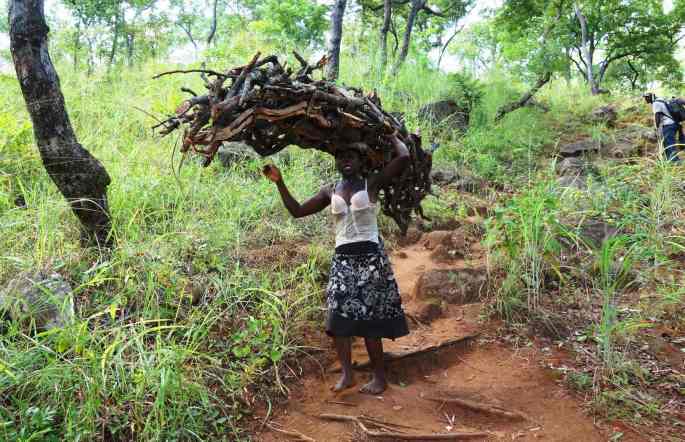
[Photo: Woman carrying immensely heavy load on her head, descending Mt. Mulanje in bare feet.]

23 April 2017

It is funny to call this little brick house “home”. But it is where we live and where we sleep and my refuge right now. I can see how attached I have been to a place, a neighborhood, a state of mind, a set of responses. My early life was in many ways idyllic: we lived on a lake, both parents were doctors, we had boats, a dock for swimming and fishing, woods to play in, friends. Then, after Dad died and we moved to Denver, more friends, good schools, ski racing in winter, working on a ranch in the Rockies in the summers.  Money was tight at times but we were never poor, never without a warm home, never hungry or ill-clothed. And then, of course, excellent colleges and beyond schooling. But my two living siblings and I cannot seem to shake our pasts, the parental failings we perceived or imagined, Mom’s depressions/hospitalizations, her competitiveness, Dad’s disinterest, self-absorption and early death. I struggle to understand why my childhood sticks to me like peanut butter on a wool sweater. I am gradually shedding some of that part of my past, but not without work.

As a psychoanalyst I have all sorts of theories as to why this is such a struggle for me, why the past must accompany my present.  Of course, old shoes are comfortable and I’m still trying to right old wrongs, to be successful where I wasn’t before, to get what I feel I didn’t get. I think another contribution, for me at least, is that I accepted my family as normal. It was what I knew.  And what I had.  Normalizing it kept me from looking too closely, which would have allowed me to chuck the bad parts. And it spared me the pain that close look would have entailed. Oh, I’ve looked at a lot of it from many vantage points in my years on the couch but my childhood dogs me like my shadow, sunshine or not.

It is strange to me, coming so far from what is familiar to me, to recognize aspects of myself I couldn’t see in that home.  It is startling to realize I am only alive in the present, in my present, and can never live in the future. Or the past. I love the Chichewa proverb: Safunsa anadya phula. If you don’t ask for honey, you’ll eat wax.  Perhaps that stays with me because I’ve struggled to feel my thoughts, wishes, and desires were legitimate.

This all seems more prosaic than profound, as I re-read it. Everyone drags their childhood around with them. But some seem confident enough to leave much of it behind. I am just fortunate I’ve lived long enough to keep questioning, molting those feathers in this Spring of my life (Actually, we’re heading into Winter, being south of the equator.).

I see real suffering here—-hunger, mental illness, early deaths, birth injuries, infidelity, abandonment of family, abuse of all sorts, alcoholism, cannabis addiction with associated psychoses, HIV, TB, malaria, and, above all, the constant insecurity that accompanies grinding poverty—and it throws a light on my struggles. Despite whatever challenges I’ve faced or not, I have led a charmed, interesting, and rewarding life.

As long as the brain and body keep going, I want to work. I don’t want to putter. And I find working in a setting like this stimulating and challenging and meaningful. Although I can struggle to recall the name of a person or place at times, I still can learn the 11 new medical students’ names in a week or so. It’s one yardstick for senility.

I worry for Malawi. Reliable estimates set the population at 30 million in 17 years. They cannot feed themselves now at 17.2 million. Governance is corrupt and there are new scandals every week, it seems, at high levels, not unlike in the US. Studies apparently have shown that above a certain level of financial security, happiness doesn’t increase a whit. And that level isn’t very high. One replaces one set of worries with another.  So why do we keep stealing and accumulating?  Like those experiments with rats and Valium—they’ll starve themselves to death, preferring Valium to food.

We walked several miles yesterday, plannng to investigate a butcher shop in Limbe whose bacon and whose beef filet were recommended to us by friends. It’s run by a Greek.  I couldn’t see dealing in dead animals, even though I enjoy eating them cooked.  [I’m a clandestine member of the alternative PETA—People Eating Tasty Animals.] The shop had closed at 12 on Saturday, so we wandered back toward home, doing small errands, like checking if my new debit card from my US bank with the new PIN works in my local bank ATM—it does. Being on a volunteer cost-of-living-plus-a-little salary, it is nice to have a backup. Linda went into a halaal butchery along our way and bought a kilo of filet mignon for the equivalent of $3.25/pound. And was it good! Well, the third of it we ate last night.

I saw a young man, a student at the College of Medicine, two weeks ago. He is a very sweet guy who has had two stress-induced psychotic episodes with associated suicidal thoughts around exam-time in the past two months. He wanted me to write him a medical letter to withdraw from the College. His older brother was with him, awaiting to take him back to the family fold in a village 12 hours drive from here (probably 24 hours by minibus). The student looked both relieved and defeated; likely he’s the only one from his village who has ever gone to university.  I don’t know how he’ll be treated at home, having set off with high hopes and returning having come apart. It makes me so sad for him. There are precious few psychological services for him outside of Blantyre. His district health center may not even have antipsychotic medications. I gave him a 3 month supply. Certainly there is no one near where his family lives trained to work with him psychotherapeutically to help him sort it all out and to strengthen him.

A Collared Sunbird—tiny, bright yellow breast, black throat with a flash of violet in the sun, blue-green iridescent cap and cape, and grey wings with a curved black beak—and his lady, less of an exhibitionist ,  flitted around the yard yesterday, giving us wonderful views of them for hours. As our banks of orange Cosmos slowly fade, they are replaced by hedges with lavender flowers and huge poinsettia bushes. We saw two 30’ poinsettia trees on our walk yesterday. It seems that whenever one flowering tree or shrub is passing, two others spring up, equally lovely.  Natural beauty is balanced.  Not trying to accumulate any more than is needed.

Mulanje Damp

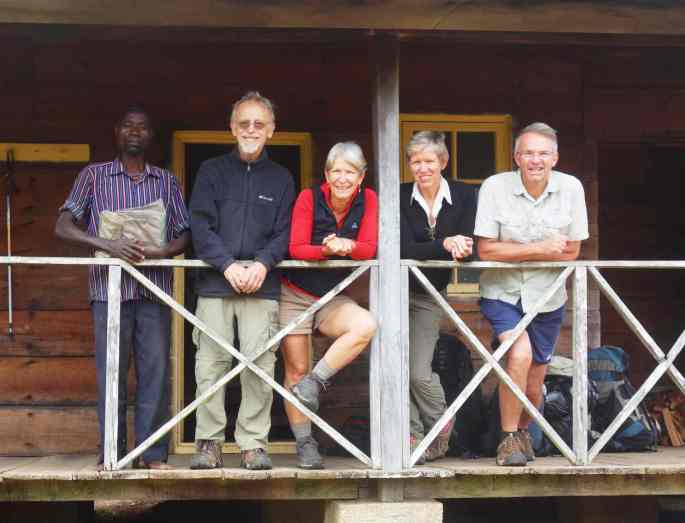
[Photo: Peter, Caroline, Linda, George and Hut Keeper at Chinzama Hut, Mt. Mulanje]

18 April 2017

Our academic cistern is nearly drained. The last rotation of 21 4th year medical students is ending; lectures are completed, problem-based learning exercises almost finished, the final rotation for the year of Scots to help us teach has arrived, and there is only one day left to supervise the students evaluating patients in clinic.  Remaining are oral case presentations, 3 minute video clips of their patient interviews, a practice quiz, reviewing their long case write-ups, the 3 hour written examination, the oral exams, and, finally, their feedback to us.  Yesterday was the next to last day of their small group presentations of learning objectives from PBL #5. One group did a quiz show live; the other performed music, complete with keyboard, guitar, dance moves and singing—-“Effavirenz, oh, oh; depression, malaise, oh, oh”—the side effects of the antiretrovirals (ARVs) used to treat HIV. It was hilarious and instructive, especially to see them all shaking their booties and loosening up. Plus, we learned, again, about the various ways HIV devastates a person.

I took two medical students with me a week ago to do a consultation in the Pediatric HDU (ICU). A 6 month old girl came to the hospital with diarrhea and weight loss. She was found to have AIDS and started on ARVs but continued to deteriorate, going from 4kg to 3 kg in two weeks. Her mother was exhausted and tearful, by her bedside day and night with no family relief or support. The students interviewed her for an hour. We then enquired of the baby’s condition from the pediatricians as we left the ward and were assured that she was “doing OK”, despite the continued weight loss. When I returned to see the mother yesterday, the Registrar told me the baby died two days after our visit. Death stalks the halls at Queen Elisabeth Central Hospital.  I told the medical students and they looked  somber. Death in hospital is so common here; I don’t know if it is the rule, rather than the exception, but patients are so ill and resources to help them are so limited.

Easter weekend was a 4 day holiday so we planned a hiking/camping trip to Mulanje. We went with our friends, Peter and Caroline, who are from Zimbabwe but, after 40 years in UK, couldn’t get a permanent passport to return, being white. Robert Mugabe somehow keeps oppressing and stealing. Only the good die young, as the lyrics go. We four, plus guide Samson and 3 porters to carry our large packs, ascended, leaving a farm cooperative 180 degrees across the massif from our first trip up, walking through lush fields of sweet potato, maize, and sorghum. Women wearing colorful chithenjes worked in the rows, singing together as the irrigation ditch delivered water to the rich, red-brown soil. A group of young girls followed us for a distance; they were delighted when we photographed them and showed them our snaps on the little LED screens.

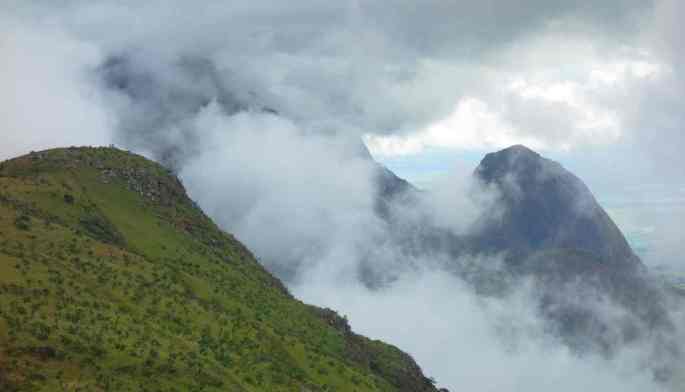
We took about 5 ½ hours to hike the 3000 foot climb to Thuchila Hut. It is a wonderful 4 room cedar cabin built over a hundred years ago, with views over the edge of the escarpment and up to the peaks on 3 sides. Instead of a meditative silence, however, we found 9 children and 5 adults (two more women came after dark). It was fun to see the kids absorbed in their play, whether exploring or playing UNO, and interesting to meet the adults, all of whom have their stories.

By morning we were ready for tranquility, however, and set off at 7:50AM to get to Chinzama Hut, which we loved when we stayed there in September. We dodged the rain, established our pace and rhythm, took photos, and marveled at how incredibly fortunate we were to have the time, resources, bodies, and desire to immerse ourselves in such beauty. Instead of the brown of the dry season, everything was green, except the flowers which included a variety of orchids, coreopsis, impatiens, straw flowers, and hot pokers, all a cornucopia of colors. We passed through a small rain forest in one valley—moss, giant ferns, huge trees all dripping wet in the sun.

Linda was our chef de cuisine and had prepared intensively beforehand. We ate like kings and queens, a newly-baked bread with each meal, omelettes with cheese, fresh basil and a side of home-made chorizo, fresh salads from our garden, and on and on. And endless cups of tea. The four of us got on like duck soup (perhaps the only dish we didn’t sample).   We each did what we wanted on the trip.

While Linda and the Finches, with Samson, headed off for a several hour hike (and a drenching), I read Somerset Maugham’s The Moon and Sixpence about Paul Gaugin, while I sat in a wicker chair overlooking peaks and valleys. I’d forgotten what a craftsman Maugham was.  And what an aesthete! Anyway it was a slim volume to carry, printed in 1935, selling then for 35 cents, and falling apart. As clouds and fog rose, I saw a wonderful photo op, so I scaled a 30 foot boulder and got my pics. It began to rain lightly but promised a downpour so I quickly decided to descend.  Unfortunately, I had pulled and scrambled my way up and found it quite daunting to go the other way. I called to one of our porters, Bison, he who won the 25Km Porter’s Race up, across, and down Mulanje 3 years in a row, to rescue me. He came and provided reassurance which allowed me to get down without injury.  Then the heavens dumped buckets which I could watch from the dry shelter of our porch.

The days passed so easily and the warm fires at night with whiskey-infused hot cocoa before bed took off the wet mountain chill. On our return to Thuchila we had the hut to ourselves, played Pounce and Brandi Dog (a British board game), and got to know each other more deeply as the rains poured.

Our descent on Monday was treacherous. Streams to cross were very full, rocks wet and slippery, and the trail very steep for a very long time. Three of us fell, a few several times, slipping in the clay turned —sic—to “slip” by the prior rain. We stayed dry, stopping for the scenery and to rest at perfect viewpoints. We watched three women carrying 15’ long bundles of sticks for firewood, gliding down the mountain in their bare feet. When they paused, I attempted to lift one of the bundles which was propped against a tree.  As I approached it with my arms open, its owner jumped back with an amused smile on her face, thinking I was going to hug her. We laughed together when I showed her how I just wanted to measure the weight of her load; I couldn’t budge it off the ground. Such deluded, frail creatures are we. I’d felt so strong hiking for the four days but couldn’t match this {probable} mother of 6 in her early 40’s!

We drove on the muddy, potholed road back to the town of Mulanje, where we each ordered and devoured a pizza and a Carlsberg Green at Mulanje Pepper. The pizza isn’t the Cheeseboard or Zachary’s in Berkeley, but tasted every bit as good.  It’s all perspective, where you are standing at the moment.

I’m off to our weekly clinic meeting, then to town to pay for the internet which was shut off last night for non-payment, and to shop for vegetables and fruit at the closest open market.  Stupidly I used Linda’s bike lock to secure our bikes and she is in Lilongwe for a meeting for several days with the key. So I have to hoof it and, believe me, the old bike saves a lot of time!

To Mdala Village

Photo: Elephant’s Head from Thuchila Hut, Mulanje

3 April 2017

I texted Sterra (actually, Stella) this morning at the Chileka District Health Center, saying I’d be coming to try to interview—let’s call her Angela Kolumba—in Mdala village today. I didn’t hear back so biked up to Queens to meet Maurice, my amiable interpreter, at the Peds Mental Health Clinic at 8:30AM.  We walked together to the minibus stop and took one for Chirembe. However, leaving the Blantyre boma (downtown) we were pulled over at a police stop. A stunningly-attractive policewoman sauntered languorously around the car, steely eyes missing nothing, saw that the minibus sticker on the windshield had expired and wrote out a ticket. Appeasement and bribery didn’t work, so the driver got out and walked off in a huff, up the block and across the road to disappear into a group of shops. So did the assistant. I offered to drive but thought better of it. Finally, the ticket was completed, the driver returned, and we set off again. This was a particularly beat-up minibus and the driver shut off the engine on every downgrade to save petrol. We finally arrived at Chirembe and transferred to another minibus for Chileka. There were never more than 15 people in the van, which was remarkable.

At the Chileka District Health Center we disembarked and quickly found ourselves in the well-baby clinic, surrounded by women of all ages wrapped in colorful chithenje’s with another tied around their shoulders and chest, holding their infants snugly to their backs. We found Stella; she is the Health Surveillance Assistant supervisor, a tough but appealing woman who quickly summoned Chrissy for us. Chrissy is the HSA for Mdala, a village of 4,700 people.  Since it was her home and childhood village, she knew Angela Kolumba and knew precisely where she lived.

So we backtracked a few kilometers by minibus to the road into the “village”, which is actually many huts planted on the hillsides stretching into the distance for kilometers. We then hired a “taxi”—the worst minibus I’ve been in, with a plywood floor, seat benches not bolted to the floor, a non-functional battery and starter motor, no shock absorbers, etc.—for MWK3000 each way. The driver was a businessman, informing us along the way that the last steep bit would cost another MWK500. It is an overstatement to call what we drove on a road and my admiration for the capabilities of these ancient Toyota beater-vans rises up several notches. This driver, as well, tried to save petrol by shutting off the motor on the downgrades, meaning no power brakes or steering, and jumpstarting the car just before the upgrades.

Once the taxi was parked, we walked up a dirt path between houses and maize fields, past children playing and housewives washing clothing, to a tiny mud-brick house with a covered verandah. A petite woman, sturdy and friendly, came out in response to Chrissy’s “Odi?” (Anybody in there?). Chrissy explained who we were and why we were there—-a doctor from the College of Medicine to interview her about her recent illness (Donkin or eclampsia-without-seizures psychosis) so he can teach other doctors how to treat it properly. She graciously accepted the package of biscuits, liter of cooking oil, and bar of soap I gave her, “God bless you for your gifts.” Then she brought a small stool from the house for me to sit upon, the plastic case for a car battery for her to perch on, and Maurice and Chrissy sat on a rock wall while we talked.

She didn’t recall a lot about her illness, saying that her legs had been swollen and that she was confused and scared. She denied hearing voices or refusing to drink or eat, as her relatives had stated, although she said she couldn’t swallow porridge one morning. Her father died two years ago, her mother lives many km away in Zomba, she never went to school, and she didn’t know what year it was. But she knew her village, the season, and the names of her neighbors, all information more important to her life as a farmer than the date. Her 6yo son was with us and she was very affectionate with him. The baby was down the hill at a neighbor’s for the morning. She told a life story of moving from place to place, never attending school or learning to read, not knowing her date of birth, and of extreme poverty. She was clearly kind and gracious and totally sane. We took some photos of us all and left after an hour. She must have thought we dropped in from outer space. Clearly a mzungu (European—white person) had not hiked through this village in a long time.

The taxi awaited us for the trip back. It was much as the trip up, except that at one point the driver had words with a young man walking along the road. He stopped the van, pulled out a long machete from behind his seat, and waving it set off across an open pasture after the other man. Needless to say, the other fled into the woods. Warm Heart of Africa, eh? I asked Maurice, “What was that about?” “They had a disagreement.” Quite.  Or as the Malawians might say, “Is it?”

Chrissy headed back to the Clinic and Maurice and I jumped a minibus for Limbe, to drop us off at Ginnery Corner by Queens. I suspect there was a distillery or a “gin mill” there at one time. A preacher in a bright red shirt with white polka dots and a 2” wide black leather belt that nearly encircled his waist twice was determined to chat me up. So we talked a lot until it finally came out I was a psychiatrist teaching at the College of Medicine, at which point his fire cooled a bit and he took up chatting with Maurice. There was a pretty mzungu girl with long blond hair and tattoos on her left calf sitting next to Maurice and the preacher assumed she and I were together. (I likely could have been her great-grandfather.) She exited shortly. We did soon after, I thanked Maurice and gave him some Kwatcha for his time and biked to Flavors for lunch.

The most remarkable aspect of this entire thing is how seamlessly it has unfolded. By some miracle I found the perinatal file and the file from the subsequent admission when Angela was psychotic easily, despite no systematic or centralized records in this huge hospital. I found Stella who found Chrissy who knew Angela who happened to be home when we turned up in our “taxi”, which is a total anomaly to find in a little village. And Angela was cooperative. And we got home without a minibus accident. Only one ticket and a machete chase. Just a day in the life of an academic (now) psychiatrist. I’ll write the paper and my guess is, since it will be the first case reported from Africa, it’ll get published easily. What a lark.  Pad my CV! Who will read the CV or care? Nor do I!

I’m thinking about Benjamin Franklin, Andre Ampere, Michael Faraday, George Ohm, and Thomas Edison. The breaker panel is fried in the Pediatric Mental Health Clinic at Queens, so I have no lights in my office there. Many of our friends have been experiencing power cuts, often for several days, despite the abundant rain and consequent flows in the Shire River which powers the main turbines for the country. Puzzling. The first floor hallway of my office building at the College of Medicine has 17 ceiling lights. 10 are not working, one is flashing, and the other 6 have half a cupful of dead insects in the bottom of the glass light cover, absorbing much of the light from the fluorescent bulbs. I note that there are no lights, or light fixtures, in the Men’s Bathroom, despite a 5 foot long urinal trough, two toilets (neither of which flush), two sinks and a non-functional electric hot air hand drier. I guess no one is expected to use the toilets after dark (about 6:15PM).  The sub-text is, “We don’t encouraged you to work long hours here.”  Infrastructure. “Towards electricity all day, every day” seems out of reach.

In closing, I have noted new wildlife in the yard. A Brimstone Canary and a group of 4 Mousebirds were zipping through the bushes. We have skinks (a kind of lizard) with iridescent blue and green striped tails. Stunning. We had an infestation of flies the other day and Chimwemwe, our gardener, noted that the sewerage outflow was plugged. That was quickly remedied by George (no relationship) Fixit, as our landlady calls him. And he can. I digress. Flies aren’t really wildlife, true enough.  I saw a group of 6 or 7  Pied Crows in the front yard two days ago. They were approaching the front terrace and generally acting in a curious way. When I peered through the front screen door, there was a large mongoose perched in the raised planter 3 feet from me. Did I jump? Yes! Google Image mongoose and you will see astounding pairings of them with cobras. I tremble merely looking at the images, several iterations removed from the real action. Oh, and the Southern (Lesser) Double Collared Sunbird pair were back in the yard. Our friends have the most amazing spider—a massive, beautiful, Golden Orb Weaver. They catch and eat small birds, as well as insects. Their webs are golden in the sunlight. And they are substantial, with gold filigree on their bodies and red legs. Make a circle with your thumb and first finger—the body is about that size. And the web wasn’t bothered by the terrific torrential downpour night before last.

We’ll hike up onto Mulanje for 4 days next (Easter) weekend. With a guide and 3 porters for 4 of us. Whiskey in Linda’s cocoa before bed is a peak experience!  And perhaps some Pounce or Nertz or whatever you call that intensely competitive, trash-talking card game.

Bringing Home the…..Green?

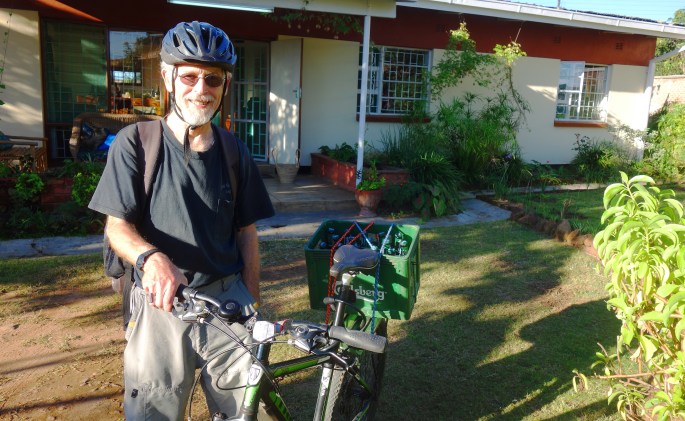
[Photo: Self-explanatory]

2.4.2017

We are neither of us big drinkers. I bought a case of beer mid-January in anticipation of Pat and Stacy coming for 3 weeks. We are down to the last beer and expecting guests for lunch today so yesterday I decided to bike to Shoprite, the closest thing to a normal US-style grocery store in Blantyre. Nothing, of course, compares with either of the two Berkeley Bowl stores which are unique in the US. Certainly Whole (Pay Check) Foods doesn’t reach the rarified foodie standards of the BB, with 16 varieties of fresh mushrooms!  So I set out on my bike, raced the couple of miles and up the fairly long second hill nearly to Shoprite when I suddenly realized I had forgotten to bring the case of empties.  I returned home, feeling dumb, strapped on the case and off I went. Traversing the crosswalk about halfway there my bike skidded and suddenly tipped over. My front tire was completely flat. So I pushed it back home, past the market where I regularly buy bananas and the occasional tomato, past George who sells me AirTel top-ups for my phone from his broken red plastic table with the faded AirTel umbrella, down the path and then down the dirt road to our gate. Once inside I took off the case of empties, removed the front wheel and the inner tube, found the leak, patched it, reassembled the tube and tire, pumped it up and reinstalled it. I even tightened my front brakes, which were very spongy. Then I again strapped on the case of empties with bungie cords and set off for Shoprite. Street children blocked my way as I turned into the parking lot, asking for “A dolla, boss.”. An (inebriated) man wanted to discuss the logistics of carrying 24 bottles of beer home on a bike rack. “It would be better if you just drank it here. Then you could give me one.” At last, I exchanged the empties for a full case, loaded up, and made it home without incident. Persistence, that’s how you get Carlsberg Green home on a bicycle.  It does make the bike pretty top-heavy.

I visited the young man with epilepsy who fell into a fire during a seizure and burned his arm so badly it required amputation above the elbow. His mother was feeding him and he looked pretty cheerful, if anxious, when I saw him. Since they speak Sena, not Chichewa, I had to locate an intern from another part of the hospital to interpret for me. Is he having seizures in the hospital? “About one a week.” I checked his chart and he hasn’t been started on the Na Valproate I suggested 1 ½ months ago. Why not? “We don’t have it”.  It is ironic, since he is here because he has an uncontrolled seizure disorder that led to very extensive injury and medical care and he isn’t being treated for the epilepsy. In fact, until he came to the hospital he has been “treating” it with herbs from the traditional healer in their village. They live far to the south and in a village far back on a mud track from any medical care.  I returned the next day with a sack full of phenobarbital and a three month supply of Na Valproate, both with directions. His mother assured me they could get to the district clinic every 3 months to refill his meds. I would have been arrested and lost my license in the US if I dispensed medications, especially a controlled substance, directly to a patient in a hospital bed. However, it seems like the best likelihood for him to take them.

I’ve been seeing a 13yo boy in 25 minute weekly psychotherapy visits for several months per his parents’ request. He is very bright and a talented athlete, according to his school, but doesn’t apply himself. His parents are hard-working, caring people. Seeing him has perplexed me, as he is unfailingly polite, proper in his school uniform, guarded, and humorless. He has seemed terribly inhibited and I couldn’t figure out why. Was he beginning to learn about his own sexuality and it frightened him?  I was not about to bring that up for fear of spooking him.  Well, last week and this he began to talk. First about rugby, at which he excels and which he loves (Judging from his father’s size, he’ll be an All-Star!) and, then about his 3 year old younger brother. He can’t stand the way Jim, let’s call him, always wants to play outside. Our talk quickly led to what it was like when Jim first joined the family. “When he was born and came home from the hospital I thought, ‘OK, he can be here for a week or two but why is he staying?’  I hated him so much.” We have more to explore but I think he’s offered a clue as to at least one reason why he curbs his aggression so violently. The irony is that a week ago I was about to suggest we take a break, as the silence in the sessions seemed so painful for him and was so tedious for me. We tried some games but he approached them in the same way, lackluster and seemingly intent upon losing to me.  My pointing that out went nowhere. How can you lose at Battleship?!  HIs dissatisfaction with the current state of therapy must have echoed my own. Or, more likely, he finally felt safe enough to begin to access his feelings. Wonders of unconscious communication! I feel like we’re moving in a direction that may be helpful to him.

I think the most important and lasting, for me, aspect of this whole experience in Malawi, and with Linda, is how much I am learning about myself. There is nothing like moving outside your comfort zone in intimate relationships and challenging settings to offer new perspectives on oneself. And when they ring true, accompanied by all the requisite shame and guilt, it is like striking gold. Sometimes like striking a gold crown on your tooth!

Tomorrow I’m off by minibus to Mdala, a small village in Chileka, a nearby district. I’ll take my trusty sidekick and interpreter, Maurice Chipwete, who is a truly fine person. We will seek the Health Surveillance Assistant supervisor at the District Health Center who can hopefully direct us to find the lady I want to interview about her pre-eclampsia puerperal psychosis (Donkin Psychosis) which I have mentioned in an earlier post. I’m taking her a bar of soap, a package of tea biscuits, and a liter of cooking oil as a gift/bribe for the interview. I hope she’ll cooperate so it can be a gift as bribing a very poor person to do something they don’t want to do feels, and is, exploitative. Yet I want to publish this paper because it can help others with a similar condition get appropriate treatment. And it has never previously been reported from Africa. More later.

We have bougainvillea growing as a tree, about 10 feet tall with a thick trunk and tendrils like a fountain of fuchsia blossoms. The cosmos are brilliant orange in tall, deep banks; apparently when they finish we’re to shake the heads and they re-seed for the next season. It is difficult to think that mango season is 8 months off!