Making Trouble For Ourselves

[Photo: Flower in the foothills of Giant’s Castle, Drakensburg Massif, South Africa]

26 March 2017

Mefloquine, our once-a-week anti-malarial medication, often gives people vivid and strange dreams. I’ve been taking it since July 2016 and haven’t noticed livelier REM sleep. However, I had a dream three nights ago in which I saw a canvas bag in the street containing 4 or 5 LARGE rats. I mean, 15 pound rats. I thought I’d better contain them because if they began breeding in the general rat population it would be a disaster. One jumped out and I grabbed him by the scruff of the neck and was going to toss him off a bridge into a stream—not very bright, as they swim well, but, hey…—but he grabbed onto my arm with his claws and wouldn’t let go. The harder I tugged at him the firmer he dug into my arm. I finally awoke with the pain of grabbing and tugging at my left bicep with ferocity. We do make most of our own problems, outside the catastrophic ones beyond our control, which are much more common in an impoverished, powerless population than in the world I inhabit. I’ll leave further interpretation of the dream alone for now; it was almost comical, though, how hard I was grabbing and tugging at myself.

A student here flunked one of his rotations, his third not-pass which means pretty automatic expulsion from the school. He’s from a very poor, single parent family, as many here are, thanks to AIDS, alcoholism, displacement to another country for work, and the general chaos and hopelessness that impoverishment and lack of education foster. And for him, without friends in high places and a well-off family to support him, there will not be a second chance at an education. Which means he can farm, be a guard, do “piecework”, or sell small things in a market somewhere. Other issues complicate the picture but it is, even so, heartbreaking to sit with him as he shouts, “I’m a dead man.” Perhaps the worst part was that he couldn’t accept his own part in it, feeling he was just “a poor nigger from the village” that the “tricky” COM powers wanted to “finish off”.

I suppose the learning point/teaching moment for me is how crucial it is for all of us, and physicians in particular, to accept we’ve erred, attempt to learn from it, and move on. In my child psychiatry training I had an argument with a therapist about a child with whom we both were involved. She argued, “I’ve been doing this for 13 years!” as a response to my disagreeing with her. I thought to myself, “Yup, and you are likely doing the same thing now you were doing 13 years ago.” I don’t know if I was right or she was right. I do know that if we don’t change and grow, especially in this field, like a plant that has stopped growing, we’ll wither and essentially die. Of course, there are all the things we do and ways in which we act of which we aren’t even aware. You get the point.

Animals seem to have fared better, likely through natural selection. The neurotic ones who kept shooting themselves in the foot limped around with a competitive disadvantage. Easily eaten, not seen as good mating material, etc. It helps to have more of your life instinctually-driven, I suppose. But then we wouldn’t have Bach or the Beatles or Shakespeare or the rest of that lot. And our diet would be pretty dull, though people can be passionate about the same bland food if there is enough of it.

Beyond the pleasure of companionship, including sex, I wonder about the moral opprobrium attached to not being strongly affiliated with a partner. Linda has been gone for 4 days at a memorial for a young PC volunteer killed in a road accident. The days have seemed enjoyably long and I’ve managed to watch a movie, read in two books, cook, putter around and generally be self-indulgent. I realize how different I am on my own, how much I always worry about the effect of my needs on whatever person I’m with. I tend to be more relaxed by myself, as many of us are. Yet there are echoes in the hall and a certain emptiness in the air. I doubt I am alone in this. It’s complicated for me to negotiate a relationship for that reason. I tend to efface myself.

To my amazement and satisfaction, all this relationship-free time has allowed me to: 1) learn how to put photos on this blog, and, 2) learn how to operate our stove. It is a fancy electric—dare I say electronic—one with a Ceran TM top and many buttons and dials. The brand name is Defy and aptly so; it defies reasonable attempts to operate. But I think I have got it now and can even program it to start and stop automatically. To operate the oven, for example, there are 3 dials, including one with 6 options of cooking with or without fans, and 6 buttons. On the other hand, I am loving WordPress, simply because I am able to force it to my bidding. Sometimes I force too hard and the entire site crashed for an hour or so today. I think I impatiently tried to perform a second operation before the first was complete. But I’m learning from my errors!

I sat on the wicker couch on the condi three days ago and watched a White-browed Robin Chat bathing at dusk. He is a handsome devil, with an orange chest, abdomen, and tail, a gray back, and white and black stripes over his head. He just plunged into the birdbath, after looking around for a potential ambush when his guard was down, and vigorously flapped his wings, causing water to spray over the lawn. He repeated this probably 10 times before feeling adequately cleansed and refreshed, at which juncture he flew off. To see a lady, no doubt. Must have had a supper date.

I must now finish re-reading Selma Fraiberg’s “Ghosts in the Nursery”, a wonderful and seminal paper she wrote about two infant/mother pairs she saw when starting the Infant-Parent Program at the University of Michigan. We’ll discuss it in the child study group tomorrow evening. It simply and elegantly illustrates many central tenets of psychodynamic therapy. It is so wonderful to read about her feeling her way along as she initiated an approach to interrupting multigenerational psychopathology.  Infant-parent programs have sprouted up in many places and her early efforts are widely emulated these days.

Certainly a repeated reliving of the bad parts of one’s childhood relationships in the present leads to misery for many.  And Dr. Fraiberg’s pioneering efforts have inspired more than a few to step off that well-worn path.

Biking

[Photo: These eggs look fairly well-protected from predators.  Liwonde National Park, Malawi]

19 March 2017

I love riding my Peace Corps bike, and it is a pretty old, tired thing. I have 3 much better bikes at home.  There is a childish pleasure is whooshing down a hill, pumping up it, feeling the speed compared to walking. There are advantages to not owning a car here, in addition to the expenses and nuisance of repairs. If we go out in the evening, we either get a ride from a friend or acquaintance or take a taxi. That way we can drink without concern of causing a wreck. In bad traffic it is quicker on a bike, as I can weave and pass many gridlocked cars. Having a car parked in the driveway is a sign—Rich Azungus (European, white) Live Here—, attracting unwanted interest. I never have to stop at police stops, with attendant requests for a little assistance. I stay reasonably fit. I don’t have to join a gym. It means that I can eat anything I want and not gain a pound. Finally, I like the concept of not burning gasoline to go to work or the store—or to pick up a solar panel. I can transport a case of Carlsberg Green, a bookcase, two bottles of wine, two of tonic, and a bottle of Malawi gin, or a large ceramic pot on my rack, securing them with bungi cords. My ambition is to carry a live pig, like the tiny motorcycles in Vietnam, but I’m not sure where I’d deliver it.

The downside is the potential for serious injury, especially from reckless or heedless drivers. Minibus drivers, like Domino Pizza drivers, have an incentive to speed. If they make 6 trips per hour, instead of 5, their income increases 20 percent. Twenty percent of very little is substantial. The roads are full of potholes so constant vigilance is required. On a hot day, it means that shirt cannot be worn again without being washed.

So, Harold, I get it, your love of riding. Stefan talks about feeling a bit juvenile whizzing down the covered walkways at the College of Medicine. I guess I do, too, but I couldn’t care. I suppose I am less concerned as I am old and not needing a letter of reference, having no academic ambitions. Although I might apply for a Fulbright to teach in some interesting place after this ends. I feel remarkably free in the world and riding the bike contributes to it.

One of the members, Sophie, of the Blantyre Child Study Group invited us for tea yesterday, with a caution that it was a pretty steep ride.  (Her husband, Erik, is a Pediatric Surgeon and bikes to Queen Elizabeth every day.  He has special permission to bike a more direct and level route, avoiding the worst of the hills and the village, through the Sanjika Palace property, the President’s residence in Southern Malawi.)  And steep it was, both down and up. It was an hour of pretty hard riding out of town, through a tiny hilltop village, over an incredibly rocky road, pitching down a near-vertical hill, and up the other side to arrive at Kwa Boxten.

Kwa Boxten is a 40 acre spread on top of a tall hill surrounded by huge trees. There are stables, vegetable gardens, and two large and lovely houses. Plus a coterie of barking dogs. Malawians are fearful of dogs, generally, and the latter keep away intruders, including the hoofed kind that would decimate a vegetable garden.

Erik’s mother was a Dutch pediatrician who started the Department of Pediatrics at QECH, as well as building the Pediatric Inpatient Units. She is 92, and reads voraciously, having stopped work at 87. It is like a step into the past to visit Sophie and Erik, although they built their own 6 bedroom house only 8 years ago. It is exquisite and comfortable, with a huge covered verandah where we had fresh banana bread and chai amid the dogs. The house is off the grid, with solar powered water pumps drawing from a number of bore holes (wells) and solar powered lights. Solar water heaters are on the roof. They use charcoal irons, as irons would draw down their batteries unconscionably. New charcoal irons are from China, and burn through quickly. The better ones are older, being used as doorstops in Europe. Erik seeks them in second-hand shops when he travels.

Living so far away does impact your social life, I’d imagine, making evening engagements less inviting. But the beauty and solitude of the place is stunning. Likewise, we were pretty spent after the ride home, skipping supper and falling into bed. A good ride.

Today I rode into Sunnyside to meet the 4 SMMHEP (Scotland-Malawi Mental Health Education Project) volunteers here with us for the next 3-6 weeks. They are lively and engaging and very interested in participating in the experience. One of them, who is tiny, standing probably 4′ 10″in stockinged feet, is a retired woman who rhapsodized about the Blantyre Central Market, which she explored on her first day here. She strikes me as intrepid and instantly likeable. Remember that wonderful editorial in Newsweek years ago by a journalist who was  4’10”? She espoused the advantages and virtues of being small: air travel is much more comfortable, as are compact cars; you eat less; you breath less oxygen; drink less water; you require a smaller amount of fabric to clothe you; and so forth. It was in response to the 1977 Randy Newman song, Short People (got no reason to live).  She concluded, “Short is the wavelet of the future.” Being of modest stature, I loved both the song (so outrageous) and her response.  Anyway, we put my bike in the SMMHEP car and they drove me home, as the sky was bawling. One of the disadvantages of a bike. Carrying a couch home would count, as well.

I think that it may confuse the medical students for me to ride a bike. I obviously am well-educated and come from the US where “every doctor is rich” (truly so, measured here.) yet I ride a bike. If you want status here, as often there, you drive a BMW or a Mercedes, not a TREK.  How nice not to care.  When I have the option, I ride on quiet streets and am always prepared to jump the bike off the road, whether over the curb or into a ditch. I don’t know how I’d fare, but it is a little like someone with a terrible, newly acquired disability knowing that they have the option of suicide if things get too tough. (I just read JoJo Moyes’ “Me Before You”, which brought that image to mind.)

I’d best stop here, I think, and help Linda with the goat stew she is making for supper guests. Jumping the curb is to avoid death, not to court it.

Of Birds, Babies, and Undercurrents

[Photo: Early morning, on a drive between Zomba and Mangochi]

12 March 2017

I’m sitting on the condi (porch) in front of our house, listening to the St. Matthew Passion, the tip of my hat towards spirituality this Sunday, and birdwatching. Linda went to church with Elizabeth, our fellow (?fella) GHSP volunteer. Raised Catholic, Elizabeth has not practiced for many years. But it’s also a cultural event to go to church here, especially if you get to one with good music.

I brought my binoculars and bird book with me and I’m astounded at the number and variety of birds in and out of our yard. I am sometimes so incredibly unobservant, or monocularly focussed on something else,  I wonder how I function. A woman I saw for several years once came to my office with a new hair style. After I said nothing—-I was listening to her carefully but certainly must have been blind—she said with mild exasperation, “You wouldn’t notice if I came in here wearing a burka.” A bit extreme but not far off the mark.

Back to the birds, there are African Pied Wagtails darting and wagging across the lawn, Pied Crows and Rock Doves flying overhead, a Lesser Masked Weaver (I cannot see the nest.), House Sparrow pairs, Dark-capped Bulbuls in the birdbath, and in the mango tree a pair of Southern Double-collared Sunbirds, brilliantly colored. The birdlife in our yard varies considerably, although the sparrows, wagtails and bulbuls are regulars. I often see Blue Waxbills and the other morning we heard a loud clamor. Looking out the window of my office we saw 8 Hammerkops perched on the electric wire behind the house. Hammerkops are very large, primitive-looking birds. As they rose from and landed on the wire, it was like an omen from the beginning of a Bergman film when the raven flies across the screen or perhaps an evil harbinger from a Hitchcock film. The lesson in it for me is to be still and observe all the wonders surrounding me, a challenge for this man of action and impulse. It’s why psychotherapy was such a good occupation for me: forced calm and reflection.

Linda goes to various district hospitals through which 4th year nurse-midwife students rotate for 4-6 weeks at a time. Her blog describes it well and it is quite amazing. On her way home she’ll often ask the driver to stop at one or another stand in the countryside to bargain for vegetables or fruit, it being considerably cheaper than in Blantyre.  I mentioned a few months ago that she came home one day with 45 mangoes of two different varieties for which she paid about 90 cents.  Three days ago she came in with two kg of wild chanterelle mushrooms. The cost: less than 85 cents per pound. We’ve had them in omelets, in a cream sauce over home-made gnocchi, pickled in a salad, and on and on. Chanterelles are great delicacies on our island in Maine when weather conditions favor their growth. Some years there are none. Others they are fairly plentiful. But I’ve never seen the size and abundance that we have here.

Switching gears, it’s funny how one thing leads to another. For example, when I finished working in clinic two days ago (exam week so no students) I thought I’d continue my efforts to beautify this sow’s ear. The new sign I arranged to have painted—

Room 6

Mental Health

—is a vast improvement. Clean, clear, simple characters, no dripping blood from the red paint, no “Psych”.

I purchased a number of small painted-on-canvas scenes of African wild- and village life. They are mass-produced, so affordable on a volunteer’s salary. I put one up in the nursing station, one in each of the two adjacent exam rooms and one in the “seclusion” room. I use quotes because there are always at least 5 family members accompanying, and often restraining, the patient. Then I put one in the Occupational Therapy room, in which we often see patients. And locked myself in. The door handle is fried and won’t open the latch. The wall stops 2 feet short of the ceiling but the latter is 14 feet high and, as I stood on a very tall stool and pulled myself up, I could see that the top of the wall was filthy. The dirt, plus the drop on the other side, convinced me not to climb over. Hmm. I opened a window onto the street and pleaded with a man to let me out. He looked a bit suspicious, doubtless thinking that I was supposed to be locked in the Mental Health Clinic.

Despite his misgivings, he entered the building into the Room 6 waiting area and freed me, whereupon I found one of our Registrar’s (psychiatry resident’s) older brothers, together with a policewoman and another woman. (The latter’s muscular shoulders and thighs and corresponding rolling gait would be the envy of Lawrence Taylor.) Maxwell, the brother, wanted to know how to get ahold of his younger brother, the doctor. The latter had left clinic for the day and didn’t answer his phone.  The short version is that Maxwell begged me to help him. His daughter’s 1 month old infant was in the ICU on oxygen but “no doctor has seen him for 24 hours”. So off we went, through corridors and throngs of people and across lawns and mud patches. Finally, I entered the ICU (only parents and medical personnel allowed) and, lo and behold, all the doctors were standing next to the infant in question. My fellow GHSPer, Anneka, is the pediatrician who was leading rounds and reassured me that the baby was fine, a strong healthy girl, and didn’t actually need the oxygen cannula in her nose. She had bronchiolitis, like many others in the ward, and was recovering.

When I stepped outside the grandfather rushed up to me, accompanied by the policewoman.  I don’t know where the splendid specimen went, nor who she was.  She may be another daughter. They were visibly relieved when I told them the story, and I was introduced to the infant’s grandmother, as well. Then I headed back to continue my day. It felt as if it had been short-circuited but, in actuality, it all was my day. Just not my planned day, as is generally the case here.

Being an ex-pat confers a certain, not always admirable, status.  A “we-they” dynamic seems to come with the territory, even if undesired.  I don’t want to join the ranks and would likely have to remain a long time before being accepted as one, anyway. The presence of gardeners, housekeepers, guards, cooks and so forth speaks of the power differential, the remains of colonialism. The latter is a fact, but it is uncomfortable to be reminded of it so frequently. My birthright was a roll of the dice and had nothing to do with my virtue. And from birth, the field was tilted in my favor, some difficult circumstances excepted.  Malawians are so generous of spirit that they make it easy to forget the other levels of discordance. But exist they do and sometimes in unguarded moments I can sense the unfairness in our respective positions and the consequent [natural] feelings of animosity.  It provides an almost-palpable void between us.  To feel it at those moments is deeply unsettling, stimulating a mixture of guilt and fear and gratitude for my advantages.

I’ll try to take and post some photos of our house and yard. I am surprised at how at home and cheered I feel by it. Linda has done an amazing job of decoration. It is nicely furnished, as well, with lovely chests and tables and chairs. We now have a little collection of Africana which, together with some antique maps from the map store [The only kind they have—and they don’t consider them antique!] and cut-outs (fish over the bathtub, butterflies in the loo, chickens in the kitchen) from chitenje pasted to the walls, create a cosy and attractive environment.

Our friend, Polly, ran the Mt. Kilimanjaro half-marathon recently and on the return flight met a newly-wed couple on vacation from Washington, DC. She is an architect, he has worked in the Obama Administration for several years. They are in the area for 3 weeks. He was a Peace Corps volunteer 15 years ago in a remote village in Zambia and is showing his lady places he loved. They are climbing the Mulanje Massif and will stay at one of the huts on top. We lent them our sleeping bags and air mattresses. Like many long-distance hikers and campers, ex-PC vols are generally a pre-selected, compatible lot.  We certainly found that to be true when hiking the Haute Route 1 ½ years ago.

Examination week is over. Only two students will need to repeat their 4th year psychiatry rotation. We attempt to make it so interesting and attractive that none will fail to work hard. And, of course, we want to recruit some to the cause. English being a second language for all of them…..oh, this gorgeous little sunbird with a long curved black beak, an iridescent blue-green cap and cape, and a red bib just fed in a flowering bush 10 feet from me!  Anyway, I admire the students for the hard work they do and know that those two will be better doctors for spending more time with us.

I seem to be drifting, so I’ll stop here. I did, finally, get my ID card. Literally hours spent by me on what should be an extremely simple task. Perhaps my experience with it is a reflection of the dark void of which I spoke above, in a passive form.

Mass Hysteria

[Photo: 9 girls, 6yo-16yo, possessed by who knows what?]

5 March 2017

Chiwoze Bandawe is the Psychologist in the Department of Mental Health. He’s also, I believe, the only PhD psychologist in Malawi. Plus, he’s a very well-known figure as he has a regular weekend column in the largest circulation newspaper in the country, The Nation, and has published several books. I was riding in a cab in Lilongwe in August and chatting with the cabbie. He wanted to know what I was up to in his country. When I told him I’d be teaching at the College of Medicine in Blantyre, he asked if I knew Dr. Bandawe. Yes, he’s my Malawian counterpart here, I replied. How did he know him? The Nation

Chiwoze was contacted by the Deputy District Medical Officer for Mangochi,  the name for both a district and a largish town sitting 3 hours to our north at the southern tip of Lake Malawi. It seems they had been investigating an outbreak of mass hysteria involving 70 children in a school which serves several rural villages 1 ½ hours to the northeast of Mangochi on the border of Mozambique. The outbreak has been ongoing since October. Would the Department of Mental Health at the College of Medicine like to help them with it?

Would we? A resounding, “Yes!”. So 5 days ago four of us set off at 5:30AM on the drive to Mangochi where we’d be met by a Land Rover cum driver and several health officials to accompany us. Our group included Chiwoze, myself, Stefan, and Lucy, Stefan’s long-time partner and an accomplished investigative journalist. We felt like we had the bases covered. Ghostbusters!

As we dropped 3500 feet off the plateau on which Blantyre sits, the temperature rose 10 degrees. In addition to the malaria and crocodiles to which I alluded in my last entry, Mangochi is hot, pretty ugly, and seriously lacking in amenities for the Western traveler. More of that later.

We drove into the Mangochi District Hospital grounds where the hospital sign assured us that it was a “Child Friendly” hospital. What, no leopards, no hyenas, no puff adders? It is not a place I’d take my child to make friends, what with the power and water shutoffs and the rampant diseases for which people are hospitalized.

We met with our counterparts (3), climbed into the Land Rover “ambulance” (no stretcher, no oxygen, no medications, just bench seats along the sides) and sped north. After the tarmac ended we had another 45 minutes on a soupy, deeply rutted mud track—a challenge to navigate—leading to the village. On arrival we discovered that they thought we were coming tomorrow. No, today. But they had received no confirmation of our ETA. We waited outside the simple brick three room building for the Health Surveillance Assistant to gather people from the two adjacent villages. The HSA is a crucial figure in village healthcare; with minimal training, they know what is up, healthwise, in a village and communicate it to district officials.

Since 90% of the “victims” are girls, the concrete benches in the main room were packed with girls and their mothers. As Chiwoze and the HSA began to explain, in both Yao and Chichewa, who we were and why we were there, girls began keeling over like tenpins.  Tellingly, no one hit their head or was injured. Mothers brought their daughters to the front of the room and gently lay them on their side as a real-time demonstration of their plight, straightening their garments out of modesty. Pretty soon 9 girls lay on the floor, eyelids fluttering. Occasionally one would shriek briefly. Another might have a limb twitch. Like dancing, there are individual stylistic differences to this “fainting”. After 20-30 seconds, the littlest girls, looking to be 5-6yo, would spring up smiling, as if to say, “I did it. Just like the big girls.” and return to sit beside their mothers. The older girls lay there for up to 5 minutes before returning to their seats.

As we gathered information from the mothers about it, there was a striking cessation of the episodes. As soon as we began to reassure them that there was nothing wrong medically and that it would go away by itself, the little girls began to drop again. Finally, after we proposed a solution, answered last questions, attempted to interview 5 girls in a separate room by themselves to little avail, and prepared to leave, everyone filed out of the room onto the dirt road in front of the building. Lo and behold, 5 girls fell out on the road, as if to demonstrate how real this was and how powerless we were to stop it. We drove off.

Our “solution”, which has been used elsewhere, is to isolate the girls who are falling out from one another until they stop. That is, out of school for a week, no contact with friends who also fall out. It isn’t easy to pull off in a tiny village which has one common bore-hole from which all water for the households is drawn. A woman proposed taking her daughter to visit relatives in Mozambique. Another mother, looking anguished, cried, ”But we don’t have any relatives in Mozambique!”  The Deputy District Medical Officer, Stalin, will keep us apprised. A recent review article on the subject correctly said don’t waste time and money and resources doing medical workups. 22 of these girls had extensive workups, including spinal taps. It is helpful to identify and isolate the “Index Case”, ie the first child to have a spell. Generally, they have a lot of exam or home or personal stress and the other girls follow suit. A diversion in the humdrum of village life with considerable attention and notoriety as secondary gain.

Since it is increasingly dangerous to drive between cities at night, we were put up at the Villa T… in Mangochi, which is a crumbling, decrepit hotel right on the Shire River. A sign at the water’s edge says, “Do not swim. Crocodiles.” You could imagine it was a place of local indulgence and intrigue in former days. Now, the silverware is dirty, there was a cockroach in Chiwoze’s cooked vegetables (We all paid the same price, shouldn’t we all get some extra protein?) and my room was amazing for its lack of comfort. The mosquito netting was for a single bed so it slanted inwards, necessitating propping up or it sagged onto my face. There was no soap or shampoo and no dish in which to hold it anyway, either by the sink or in the shower. There was no hot water, so cold showers for me. The toilet didn’t flush—no water came into the tank, so it was unpleasant as I left it. There was a flat-panel TV of the miniature variety but I didn’t attempt to see if it worked. We had been subjected to a soap-opera on TV during supper. A man was cheating on his wife. Both she and the “other woman” looked to have Borderline Personality Disorders, with massive breakage of glassware and a large flat-panel TV, histrionic rages, threats to kill themselves, etc. A real busman’s holiday. The place is owned by a professor at the College of Medicine, presumably as an investment. I feel for him.

We were so happy to return to our respective homes, Mission Accomplished. Maybe we’ll write the incident up for publication, if only in hopes that someone who reads it will not do spinal taps on groups of school children in the grip of an epidemic of hysteria.

A side note. Our new digs are so much nicer, if more modest, than the other house. We’re down to one bathroom and about ½ the square footage in the house, but the yard, garden, quiet, privacy, and feng shwei of the place make it feel like a home.  Whew!

The Wheel Turns Slowly

[Photo: Whaddaya mean, homely mug? Liwonde National Park, Malawi]

26 February 2017

This is a banner day! After 7+ months of working here as a full-time Honorary Lecturer I have a Contract (completed 1 month ago) and today I have been informed that if I show up at the Medical Library at half eleven the photographer will take my headshot and it will, soon, be turned into an ID card which I shall wear on a lanyard around my neck when working. All the medical students wear them. The interns wear them. The registrars wear them. All faculty wear them.  When I go onto a ward to do a consultation, guards and nursing staff will no longer look at me suspiciously, I’m hoping, an unidentified man come for no good purpose.

Things generally move slowly here, especially if it has to do with paperwork and forms and desks. Rather than gnash my teeth about it, I’ve decided to see it as a difference, not an evil, and seek out the good in it. Have I gone over to the Dark Side?  Given up? There are advantages to being able to slow down, not to race around frantically as Americans, at least urban Americans, generally do. In any case, I cannot turn the river around and swimming against the current is a futile, exhausting proposition. So maybe I’ll keep afloat and see where it takes me. Probably to living in a mud hut, eating nsima and mice on a stick!

It feels so wonderful when something actually happens, after so many trips to the Registrar, the Principal’s Secretary, the library—is the photographer really on salary? I’ve sought him out many times and he has never been there once. Ever. Oops, got to float with the current here.

This morning the water was streaming out of the hot water tap, rather than trickling. It actually came out of the shower, as well. So I turned the hot water heater back on after 3 weeks of tepid bucket baths. And the stove, which blew the main fuse breaker several times last week so we have been having one-dish meals cooked over the gas burner, went on this morning and didn’t blow the breaker. Are things repairing themselves? How can inanimate objects self-heal? Well, I don’t have to ponder it too much, as we’ll move to our new digs tomorrow. With newer appliances.

I am so glad that the medical students are software-fluent. While showing the video clips yesterday of each of them interviewing patients in clinic, the sound went off. We watched one of them without sound, able to comment on their posture, eye contact, hand gestures, positioning, etc. but couldn’t get their voice tone, pace, and volume. All the interviews were conducted in Chichewa so I wouldn’t have been able to comment on the content, in any case.  I asked one of the students to monkey with the situation—-the mute was off, the volume maximum, the cords all plugged in—on my laptop and he promptly fixed it. Using a different video player. Who knew? Not I.  There are often laptop-projector-speaker discordances at lectures and conferences—-whoever figures out a universal plug and play for all PowerPoint projectors coupled with all laptops will earn a fortune and prolong the lives of academics significantly (not to mention their hair-pulling).

One hour later……………………….

I spoke too ambitiously about my ability to ease into the Malawian current. I went to the photographer in the library at 11:30AM, at the time he suggested we meet for my ID photo. No photographer. Waited 10 minutes. Uh uh. Asked at the front desk. They were helpful and tried to call him but his phone is turned off. Did he know I’d be calling? Seething, just a bit. I am not a mellow person, as those who know me will vouch. I can fake it for so long, but as Woody Allen said, ”Then I just get rotten.” Others raised their eyebrows, shrugged their sympathy, sighed a familiar sigh. If I had been a pushy jerk or had been lazing around, I might feel some responsibility for causing this. But I work like a dog— perhaps as instinctually as a dog, it’s true—but work I do. And polite I am. Greeting everyone, which I like, as they greet me back with a smile. But, really.  No ID badge this time around. I only wasted about an hour, all told, today on it. Tomorrow is a new day [to waste]—is that how that saying goes? I do feel like breaking something—a nose or two. Violence has not been my stock in trade. Freely associating here. Maybe it’s a test which, if I pass, will allow me honorary membership in the Malawian Association of Stallers and Dodgers. I have to add, the great majority of Malawians I have met are upright, hard-working, thoughtful, honest, true-to-their word people. This crap exists everywhere.

One day later….

We moved with the help of our very gracious landlady, who lent her truck and her gardener to carry things the ¼ mile to our new place. Moving everything took 2 ½ hours and that included eating wonderful BLT’s she (Carole) brought for us. I should add that she took us out to supper the night before at a wonderful large home being transformed into a B&B by a friend of hers. We were the only diners, sitting on a porch on the downslope of a hill, bathed by the warm Blantyre evening. The food was very good. She also had the house completely painted inside and out in anticipation of our moving in. And it is remarkably nicely furnished, completely. She is Zimbabwean, her father was from UK and trained race horses on their farm, among other things. Her husband, 4 years deceased, started an electronics/computer business here that was very successful and eventually was bought by one of the two large telecom companies. She lives in a huge house on large, fenced grounds with 5 staff in Limbe, a large suburb of Blantyre.  Lots of interesting tales there, I’m sure. We’ll reciprocate her generosity.

The new house, about half the area of our old one, is cozy and we feel instantly comfortable here. The three drawbacks are: 1) the loo is separate from the bathroom and hasn’t its own sink; 2) the kitchen is tiny—think cooking on a 35’ sailboat; and 3) there is only one bathroom. But we each have an office cum guestroom and the grounds are wonderful with two mango trees, a lime, an avocado, and a guava. Plus,  it is exquisitely landscaped, thanks to our Day Guard/Gardener, Chimwemwe. He is a bright, helpful, energetic man who is a joy to have around. And there is a large, productive vegetable garden full of greens, herbs in pots, and a crop of sweet potatoes at the moment. It is actually closer to work for me, if that is possible, and about the same distance for Linda. This is full of promise.

I’ll seek out the photographer again tomorrow to try to get my ID badge. I can’t believe that I am concerning myself with this but it has become something of an obsession. I know once I have it that I’ll just wear it and forget about it. So fickle, so adaptable. Still, it has allowed us to inhabit the poles and the tropics, perhaps not such a wonderful thing for Mother Earth.

On the Trump scene, each day brings new and outrageous excesses.  It’s easy to see how Paul Ryan was elected as his high school class president one year and the next won the “Brown-noser” award at the high school. He and Senator McConnell are beyond disappointment. It’s ridiculous but where are the good old Republican Party days of lyin’ Richard Nixon (started the EPA, Clean Air Act) and stumblin’ Gerald Ford? Those who long for a return to the 1950’s clearly aren’t gay, women, or people of color. It is heartening to see how much energy is raised in opposition to these latter-day carpetbaggers, promising the world while they pull the rug out underneath those who are without (poor, immigrants, transgendered, those silly people who actually need health care but couldn’t afford it before ACA, and on and on.).

I email my Senators and Representative several times a week, encouraging them to separate themselves from what appears to me to be a ship headed for the rocks, drowning many with it. It takes courage, and conviction, to do so with a newly-elected president who has the full backing of the Senate Majority Leader and the Speaker of the House. How much easier their lives will be if they just go along.

The clouds have rolled in here and rain is pouring down to the score of the Goetterdamerung. A rainy, restful Sunday at home in Blantyre.

Malawi Grab Bag

[Photo: Malachite kingfisher, building a dwelling in the mud bank. Liwonde National Park, Malawi]

15 February 2017

I feel so fortunate in many ways. I do have a litany of misery I could recite but I am astounded to be able to do what I do at 76yo. Teach, give, hike, bike, love, write. Argue, hate. Even 10 years ago 2020 seemed very distant.  I thought, “I’ll be 80yo and the game will be up. “  I think not. I plan to go until 2056 so I can wear out the ostrich skin belt I bought at the Indian Spice Market in Durban. I’ll be 116yo.

As I was biking around trying to do errands and get the electricity fixed—a bad main breaker switch goes off 4x/day on average, turning off the fridge for the weekend if we go away—I happened on the Blantyre Power Station.  ESCOM, the Electrical Supply Company of Malawi, Ltd., has the motto on their trucks: “Toward Electricity All Day, Every Day”. Before you burst out laughing, as I did, if you realize that this is one of 3 poorest countries in the world, it’s pretty amazing to aim for that. Of course, their logo says, “United We Stand; Solidality Forever”.  At least it didn’t say, “Untied We Stand…”.  “R’s” and “L’s” are fairly interchangeable here, so it isn’t as outlandish as it may seem.

I rode up to the hospital yesterday and saw a woman crawling on her hands and knees, pretty rapidly, toward the AETC (Adult Emergency and Trauma Center). I was a bit perplexed that if she was too ill to walk, how could she speed along so well on all 4’s? I mentioned this to the nurses and one of them wondered if she were paying some sort of religious penance. I suppose it would really change your perspective if you went around on all 4’s; you might feel you’d done adequate penance.

I saw a child last week in Peds Psych Clinic, Scoffa. He is 12yo and is dying of HIV/AIDS. The last two times I saw him he was delirious, skeletal, eyes like a Keane painting, crying unintelligibly, undressing, running around in the room, and slapping the desk really hard with his open hand. He is an inpatient and has come to see me from the Peds Ward.  I was packing up to leave as the morning rush was over and he hadn’t come. I assumed he had died. But I looked outside a few minutes later and there he was with his mom. I hardly recognized him. He’d put on a little weight in a week, was calm, and looked me in the face and said, “I feel just fine now.” Antiretrovirals are amazing!  It was truly unbelievable.

I saw another child in consultation in the Peds Special Care Unit. He had been found in a bush outside a local town and taken to the police who brought him to Queens. He was mute and appeared to be about 6yo. He looked terrified and with good reason: his anus was dilated and lacerated, suggesting he had been raped. He also had a fecal impaction and when he was anesthetized and disimpacted, they found dirt and sand mixed with feces. It is unclear if he was eating them or how they got there. In any case, they had paired him with an ample, warm, maternal woman who would be with him during his stay as a surrogate mom. She had managed to get out of him that his name was Atapa. But nothing more. He didn’t look learning disabled, just traumatized. He was treated for presumptive STD’s and given HIV post-exposure prophylaxis.  He was eating well. When I went to see him with the medical students a few days later he had been discharged to an orphanage in the town where he was discovered. Maybe parents can be found. Was he kidnapped? Was he abandoned by his relatives? Happily, the guardian with him as an inpatient will continue to be with him for the foreseeable future. Some continuity of attachment, however slight.

At our department meeting today we made plans to go 5 hours north and east, towards the Mozambique border, to visit two villages and a school. Many children from those two villages are participating in mass hysteria and the school and district health office want some help to decode and stop it. We’ll all go: Stefan the Director, myself, Chiwoze the only Malawian PhD Psychologist, and Mzati who is a journalist turned sociologist. We’ll have to spend the night in Mangochi, which is crocodile and malaria central. Plus, hot as Hades and subject to water and electrical cutoffs regularly, making emergency surgery at the district hospital at night, for example, pretty dicey. More about this after the trip.

We plan to move in ten days to our new digs. I went there today to lock up after the carpenters had put up the window screens. It is cute but tiny compared with here. I hope we don’t get underneath each other’s feet. It has a huge, lovely yard where we can sit. And I got an estimate from the carpenter for a thatched-roof shelter off the kitchen—about $65 which we can afford. Since it is always t-shirt weather here, it’ll be like another room. We may build an open-sided rondavel, a round, thatched-roof hut where we can put a table and chairs to be outside.   I need shade and to use plenty of SP 45 sunscreen in this climate with my Scot-English skin.

Speaking of Scots, Burns Night (in honor of Robert Burns) was a hoot. Lots of men in kilts with dirks and sporran. The mistress of ceremonies, a very pretty, tall, young, willowy Scot (dentist), danced enthusiastically with her be-kilted Malawian boyfriend who is fully a foot shorter but very lively. Some humor roasting the opposite sex. “The quickest way to a man’s heart? A long, sharp blade through the chest.” And, “The bank robber had the teller fill his sack with money, then said, ‘You’ve seen my face’. and shot her dead. He wheeled around and saw a customer, mouth agape, staring at him. “You did, too”. and shot him. “Did anyone else see my face?”, he demanded. An elderly lady looking at the floor softly said, “I think my husband may have caught a glance.” Then there were toasts to the haggis and we got sweaty doing Scot line dances. Very fun and silly.

We are taking Chichewa lessons and for some reason—lazy, busy—I haven’t been studying. I am the dunce in the class and it gives me new sympathy for dunces. Dreading the teacher calling on you, feeling shame that you are such a loser, even concerned you are embarrassing your significant other. They haven’t given me the tall, pointy hat and sat me in front of the class yet but they well might have. I’d add, in my defense, that, except for Linda, they all have brains the age of my grandchildren (if I had any). Sponges. Mine is more like—-a stone?

We spent this weekend with friends at Lengwe National Park in southern Malawi. The park hasn’t been managed well and all the large, edible animals have been poached. The trip was arranged through the Wildlife Society of Malawi, of which we are now members. The centerpiece of the trip was a 3 hour airboat (Think of a huge, noisy engine with a massive fan attached to the back of a 20’ long flat-bottomed skiff carrying 8 people that can plane over tussocks and floating islands of greenery.) ride into Elephant Marsh. The latter is 150-450 square miles of swamp, depending on the flood stages of the two rivers feeding it, discovered by the missionary David Livingstone in 1859 as he was ascending the Shire River from the Zambezi. He sighted 800 elephants. None are there now, although there are some hippos, alligators, and a magnificent array of birds. After an hour or two I wished I was paddling quietly in a kayak or a canoe because of the noise. We saw a spectacular number of gorgeous birds, however. We then spent the afternoon cooling off in the pool at the lodge, eating braai (barbeque), and playing a British board game called “Brandi Dog”. I do long for an Anchor Steam beer or some beer with a bit of a bite; Carlsberg Green is pretty blah.

I wrote earlier about a case of Donkin Psychosis, a post-partum psychosis associated with pre-eclampsia and which is cured rapidly with antihypertensive medication.  The world authority is a Brit with whom I’ve been put in touch. He was very excited to hear of this case, as none have been reported from Africa.  I think I’ll write a brief single case report of it for publication. To do so I must locate the medical records. I went to the gynecology ward two days ago where I was directed to their record storage room. 4 desks, 4 employees at the desks, loud Afropop on the radio, and zillions of 10 inch high bundles of loose paper records tied with string. And floor to ceiling cubby holes running the length of one wall filled with similar bundles.  As luck would have it, filing was about a month behind and as three of us began to sort through 3 stacks I quickly found the record of her recent admission. I could not believe it! So I removed it briefly and made copies.  This week I’ll try to find her perinatal record documenting the details of her labor and delivery. Knowing how inadequately documented the records are, I may have to go to her village with an interpreter and interview her and her family.  All in the interest of disseminating information to improve medical care. I know I would have begun her on an antipsychotic and been amazed at how quickly it worked to reverse her psychosis—-when in fact it would have been irrelevant to her care.  The antihypertensives were all that were needed.

This is a scattered note, I realize, reflecting my mind at the moment. I’m going to study Chichewa for at least an hour today. And finish up a lot of other stuff. We returned from Lengwe this morning by minibus as our friends had a village obligation in a different direction. It was a comfortable, not terrifying, ride costing $1.30 each for the long journey up the escarpment from Chikwawa to Blantyre. On our walk home from the minibus stop we were happily surprised to see that one of the footbridges we use to access a path through the cornfields to our house had been repaired and was being painted robin’s-egg blue. Previously one had to cling to a railing with both hands and scuttle, crab-wise across on a stringer, as there was no floor. Today we strode across, saying, “Chabwino!” (Pretty) and “Zikomo” (Thank you) to the 4 workers. Progress in Malawi!

Mvuu Camp

[Photo: Sunset over the Shire River, Liwonde National Park, Malawi]

5 February 2017

We are sitting on the front porch of our chalet at Mvuu Camp in Liwonde National Park.  We’re on a low bluff overlooking the Shire River a few kilometers south of its exit from Lake Malawi. Heavy rains—-we had 6 inches in 12 hours the other night—have caused the tributaries downstream to drill new streambeds and to flood with such force that the surface of the river is now flowing north, although the deeper water, our guide assures us, is still going south. All manner of water hyacinth and logs dot the surface of the river, punctuating the slow-cruising, sinister-looking crocodiles heading toward a meal. Hippos across the river belch and fart and groan and laugh and splash, frogs are peeping vigorously, and the birdsong is nearly deafening. Periodically a bird, large or small, will fly overhead at a low altitude, appearing suddenly from behind the fever trees and the mohane to surprise us. Hammerkops and Hadeda ibis, which are very common, are huge and loud and we both startle. It is 5:30AM and the sun hasn’t yet risen so the light is perfect, softening everything. Maybe when you get old, really old, and your light begins to dim this is what happens: everything is a bit softer. I recall my Uncle Fran calling me to say goodbye before he presumably took an overdose of (?) opiates. He had pancreatic cancer and felt his time had come. When he called me he was being pushed in a wheelchair around Green Lake in Seattle by his youngest daughter, Ellie, and described the beauty of the sun and trees and water with near-ecstatic enthusiasm.

Whoosh! We heard a loud, growing roar from the north and a very dark cloud accompanied by a powerful wind has come through, dumping a tropical bucket of water on everything. It is dramatic and exciting and fun; we’ve had to retreat to the inside of our chalet, although we have the same sweeping views as before, just obstructed by mosquito fabric.

We’ve come here for three days. We were driven to Hippo Lodge on the banks of the Shire, two hours from Blantyre. There we boarded an outboard skiff and whizzed for 45 minutes the 26 km upriver to Mvuu Camp and Lodge, the fancy resort in Liwonde. Linda cleverly found us a very cheap deal, game drives and river cruises and meals included. It is once a year for Malawi residents and their guests and we now qualify.

The camp is simply gorgeous. The rainy season has turned everything green and the world is bathed in chlorophyll. The buildings are stone with thatched roofs and open to the world. We’ve seen all manner of spectacular birds, monitor lizards, a little python, kudu, impala, baboons, vervet monkeys, a civet cat, wart hogs, bush pigs, a dassie, waterbuck, elephants, hippos, and, of course, the sinister crocs. You don’t swim in this river. Game park restaurants always feed you too much so it is generally better to eat a substantial breakfast, a large lunch, and an MGT (Malawi Gin and tonic) or Kuche Kuche (local beer, large bottle, low alcohol content) for supper, since much of the day is spent sitting down in a boat or a Land Rover.

I have sent in my request to extend my GHSP service for another year. In the end, I couldn’t think of anything more interesting, workwise, to do at home. I am not here to assuage my liberal guilt. I could better do that, in many ways, staying at home and working with needy populations, of which we have plenty. I’m here to do work I think is useful in a setting and culture that is interesting to me. I’m not a big believer in altruism; we do what we do for self-ish reasons.

Some among us cannot seem ever to get enough—-money, power, food, possessions—to satisfy ourselves, victims of our inner emptiness and subsequent greedy hunger.  These, I think, are the people that need to be restrained, since when others are hungry, their overabundance should be shared.  Our president seems to be one of these.

The wind has eased and the rain is lessening for the moment. Now thunder begins to roll. It may be a lively day. We’ll have breakfast at 7, a game drive or riverboat ride at 8, and head back to Hippo Lodge at 11:30, to catch a minibus to Blantyre. We came down in a taxi, which was very comfortable. But Pat and Stacy want a minibus experience, the full Monty.

The roads in the park flood with heavy rain, as the terrain is very flat and runoff is slow. Yesterday on our drive we went through a gully and the water covered the hood of the Land Rover. Most of the 4 wheelers have an extension to the engine air intake that is elevated halfway up the windshield, so they can go through 4 feet of water. Necessary, as we saw.

I’m going to see a man in two weeks who has no sexual desire for his second wife. The first marriage ended because of the same. He has had a medical workup and is all OK, including his endocrine function(s). I’ll need to frame our discussion thoughtfully. I don’t fully understand the problem, but since homosexuality is a crime punishable by imprisonment here, I’ll be careful. It demands the death penalty in at least one other African country.  And perhaps that isn’t the issue, but it is one possibility.

Switching topics, one thing I’m learning about working with learning disabled (read mentally retarded) children and their parents (pretty exclusively mothers), is that the latter want to come regularly to talk about their kids and struggles, even if all I have to offer is trying to understand their plight. If I suggest they return in 2 months, they look dejected and say they’d like to come in one month. So I accede. I have to accept that what little we have to offer feels like something important to them. A mentally ill, or learning disabled, child is such a burden for any parent in so many ways. And especially here, where there are only rare schools that will accept such children, let alone other therapeutic modalities.

We struggle with what is happening in the US. It is a symptom of how sick our System of Government has become that people, in desperation, vote for anyone who is perceived to be an outsider. Until we have publicly-funded elections, abolish the Electoral College, declare Citizens United unconstitutional, and have a truly progressive income tax, Washington DC will be a cesspool of influence purchased. I suppose one response is to select the biggest bully who’ll say “Fuck you” to the Establishment and hope he will follow through on it in a constructive way.

I don’t think DT is that person. I don’t think anything in his history says that he is. And surely nothing he has done since taking office says that. We’re in for a bad, bad ride. While part of me wants to be home to join the fight, another part is OK with being here and gaining the perspective I do from living in Malawi.

Adapting To Life

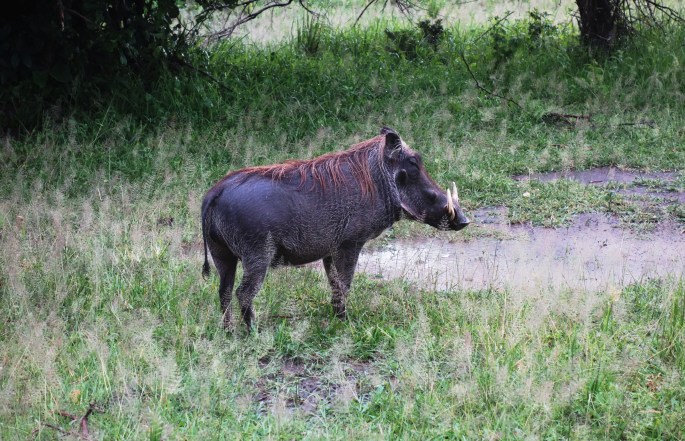
[Photo: Warthog, Majete National Park, Malawi]

30 January 2017

I’m on the bus to Lilongwe. I paid for the AXA Executive Coach, which is non-stop and has snacks and a bathroom. It is always totally full, crammed with people into tiny, distinctively not executive seats. I missed it, thinking it left at 7:30AM. It left at 7 so I’m on the local, which gets in an hour later but is only half full. I have the entire rear seat to myself; if I were tired, I could stretch out and snooze. I’m not, so I can spread out my stuff and write, knowing I am probably in the safest seat in the unlikely possibility of a crash. (That sounds a bit like the Carlsberg beer slogan, “Probably the best beer in the world.”  Not totally convincing.)  Unless the engine explodes underneath me, in which case I shall take the little red hammer from its hanger and exit a window promptly.  The very back of the bus exaggerates the bumps in the road, however, and I often type gibberish or grab my laptop before it sails off onto the floor.

Yesterday we rented a car and drove to Mulanje. Linda’s very long-time friends, Pat and Stacy, are here from Santa Fe for 3 weeks.  Pat’s a gastroenterologist and will teach at Queens; Stacy’s a retired attorney who will help with fundraising at Samaritans, the orphanage where I consult. We drove to the massif and partway around it on a dirt road, heading toward a forest lodge for lunch. On the way we passed through a small village and were approached by all manner of young men trying to sell us hiking sticks carved from Mulanje cedar, wanting to guard our car, and asking us to hire one of them as a guide to hike to the well-known nearby waterfall. I heard, “George” and looked up to see Lucius, who was a guard at a home on our street last Fall. Needless to say, we bought the hiking sticks and hired both Lucius as guide and his friend, Alex, as guard. The hike to the waterfall was gradual, took about an hour, and the destination was very lovely, with a deep pool for swimming. We waded, not having bathing suits. On the path I spoke with Lucius about his life. He grew up in this tiny village at the foot of Mulanje. When he was in 10th grade, three years ago, both parents were travelling to Blantyre in a minibus that collided head-on with a truck. 15 dead, including his mother and father. He had to drop out of school to support the family. His two sisters are in school and he plans to return when they finish. There is a rueful sadness in his face as he tells me his story. It is like so many here, totally unfair and tragic. Only an extreme and heroic effort on his part, tempered with plenty of luck, will allow him to move beyond scratching for his subsistence for the remainder of his days, and he’s not yet 20yo.

I saw a 10 yo girl, Tokozina, as my last child patient for the day on Thursday. It was our second visit and promised to be lively. She’s had cerebral malaria and is the most hyperactive child I’ve ever seen. She is only moderately learning disabled, I think.  On the first visit she bounced all over the room, running like a flash, grabbing and tossing things, singing loudly while her mother ineffectually tried to contain her by reaching out as she flew by, etc. This mother is built like a tank and could give Mike Tyson a run for his money. On Thursday I told her they could only come into the room if she held her daughter on her lap. Well, that lasted about 15 seconds as the girl squirmed away and bounced all over doing her mischief. Seeing how ineffectual the mother was, I decided to model a safe, painless restraint. Needless to say, I ended up lying on the floor restraining her while she spit in my face and then urinated on me. I held fast and she calmed. Then I gave her to her mother who did the same and, after some tears, the girl accepted the inevitable and fell asleep in her mother’s arms. After wiping off the spit with my handkerchief and letting the pee dry on my soaking pants, I congratulated the mother on her success and impressed upon her the importance of training her daughter by performing a similar restraint whenever she was beyond the control of words. We’ll meet again in 2 weeks and assess the results. It felt like a very successful intervention. I, of course, will need to explore with the mother why she has held herself back so much.

A 12 yo boy was brought in by his mother. He’d undergone a “personality change” since being attacked by a neighbor in their village. Andrew ate a peach from the man’s tree so he threw Andrew to the ground and stomped on him, fracturing his left tibia. Andrew, always a gentle boy, has become aggressive, beating up his friends. He was expelled from school for fighting, despite being very smart and an excellent student. Another boy, like Japheti, with a persistent and loving mother who is determined to help repair the damage to her son. He was seen in Peds Emergency and, since he had a personality change in this land of cerebral malaria, HIV encephalopathy, and various forms of meningitis, instead of taking a careful history he has had performed all variety of laboratory investigations, including a lumbar puncture. Some training is needed there, no doubt. His response to the beating includes “identification with the aggressor”, his adaptation to feeling helpless in the face of a threat. It is the particular form his PTSD has taken.  He and I had a good talk, he was very engaged, and he agreed to return to school and attempt to not fight when he was upset. We’ll see. He is very bright, speaks English well, and is an incredible artist.

I’m going to Lilongwe to use the notary services at the American Embassy to finalize papers for the sale of 2840 Webster Street in Berkeley, our home for 25+ years. That should be the last formal exchange between my ex and myself, which will be a relief to us both, I suspect. I’ve felt I was in the grip of a python during the divorce—each time I exhaled (made an offer leaning in her favor), the coils tightened. Rather than becoming more flexible and fair, she’d demand more. So, as sad as it is to me to have not been able to grow in our love for each other as time passed, there is a time to hold ‘em and a time to fold ‘em. I only can hope that my children, each of whom I love dearly, can accept their disappointment at the end of the family as they knew it and wanted it to be and can view each of us as individuals with flaws and foibles but basically having given our best for them. I miss them both very much.

These are the hungry months in Malawi, when the maize is growing tall but not ready for harvest and last year’s supply of corn meal is exhausted. Many of the 85% of the population that are small-hold farmers and their families are lucky to have a single, modest meal a day. It kills me to see the greed and waste in America and the “America Firsters”. It is a sad fact that we, of all the animal species, appear to have an insatiable desire to buy and possess. It is powerfully fed by the advertising/marketing industry and the mythology of our lives —–that it is better, somehow, to have more and bigger and newer and more extravagant. Rather than to have enough for reasonable comfort and to take pleasure in the greater good that everyone has the basics. It is so easy to see someone on Welfare as a “loafer” and “getting a free ride”—-I think they are sad, have low self-esteem, and have lacked the good fortune, perhaps the gumption, and the skills to do work that will bring them satisfaction.  Let’s re-establish the WPA and employ the unemployed while they learn skills and repair our infrastructure. But then, I have never wanted to not work, really.

I’ve had thoughts of spending the summers on the island in Maine and the rest of the year travelling, writing, and schmoozing with friends. I understand that most people haven’t had the good luck to have trained for, sought, found, and performed work that they truly love and which remunerates them reasonably. This is often for lack of opportunity but may have multiple and converging reasons, including their drive, intelligence, capacity to persist, lack of skill, market forces, and so forth. So people cannot wait “to retire”, understandably. For me, I find learning and being inspired by people’s struggles irresistible, so it doesn’t feel like the time to fold up my tent.

I find Mr. Trump’s lies and hatred—just look at the expression on his current wife’s face after he reads her out in the 8 second video on YouTube—frightening, since he sits now where he does. We’re not just in for a fire sale of America to the superrich. That has been going on for the past several decades. We are now rapidly heading toward a fascist state, seeking total control of media with an essentially slave underclass that will include most of us. It seems there may be a violent revolution, given how polarizing, aggressive, and dissimulating Mr.T. is. One can hope for a coronary event or a cerebrovascular event or perhaps a metastatic event (in response to his near-constant exposure to Agent Orange!). I’m not savvy enough about economics to fully understand how we’ve arrived here. Our industrial output is up but well-paying, secure jobs are down, partly due to outsourcing but hugely due to automation. Paradoxically, I suspect that many of the same people who have been left behind in our economy shop at Walmart, buying those inexpensive outsourced products made by people in China and Bangladesh who have taken their jobs, keeping those sweatshops going.  The latter have certainly been eased into slavery, out of personal desperation. Just read about their wages, their working and living conditions, their polluted air and water, and the fragmentation of their families and their society, if you doubt me.

This post has gone on too long. I am passing through emerald hills, dotted with thatched mud-brick huts, all covered by the fluffiest, most towering cumulus clouds imaginable. Even all the plastic trash has vanished from the roadside, hidden by the tall grass. It is stunning.

Early in the morning, as I biked past the local open market on my way to Queens one day last week, I saw  the stall keepers arriving with their vegetables or used clothing as they do each day, often 7 days/week. I realized, at a new level, this is their life.   They may instead sit at a card table and sell lollipops or AirTel or TNM phone top-ups, but they have no hope of a better living or life than they have right now. No kids in college, no promotion in the works, no end-of-year bonus, no cashing in on the sale of a start-up, no job or food security, no minimum hourly wage, let alone no luxury items, no increased reimbursement from a health insurance company, and so forth. And this is largely because of the cards they were dealt. Most are smart but have little schooling. Yet they are cheerful, laugh, and are pleased when I say a phrase or two in Chichewa to them as I buy some bananas or a pineapple. Humans are amazingly adaptable.

I hope our country doesn’t adapt to what our president offers to us, or tries to force upon us.

Of Pottery and Passions

DSC00559
Flowers on Dedza Mountain Dedza, Malawi

22 January 2017

As we squeezed into two of the three tiny seats in row 2 on the “Big Bus” to Dedza, the ample man in the third offered me the Saturday “Nation”, one of the Malawi dailys. Reading it was much like other issues: descriptions of government officials being dismissed or investigated for corruption, tales of young girls in villages having to perform sexual favors for their chiefs or aid workers in order to get their ration of food, etc. I thought I’d write about that but as we got off the bus, it turns out he gave me the paper before he’d read it, so I returned it to him and don’t have it as a reference.  

Dedza Pottery is a very large compound 5 km. outside the town of Dedza.  It has been around for decades and the potters make lovely and whimsical stoneware pottery. There is a lodge and restaurant, as well, and Linda and I spent two nights here before I headed north to Mzuzu to teach some child psychiatry to clinical officers and nursing students at St. John of God College and to learn about their remarkable (by reputation) programs for the mentally unwell, the addicted, and mentally retarded (Learning Disabled) children.  Linda will return to Blantyre to teach this week.   

The Pottery is in a lovely setting, surrounded by lawns and flowers and trees and, beyond the property, hills.  We happily walked here after the 3 ½ hour bus ride and the countryside became increasingly beautiful, always shockingly green and punctuated with small (800-1200ft) mountains. The area has been clear cut but there has been an active reforestation project here for 10 years and the young pine forests soften the rocky slopes of the hills. We climbed to the top of Dedza Mountain with a guide; the view of all the undulating greenery below was refreshing after the plastic trash and deforestation in a lot of the South. 

During the past week before leaving Blantyre, I evaluated a man, 50yo, who was lying on the concrete floor of the clinic for a couple of hours, screaming. We were very busy and after briefly assessing that he wasn’t perishing, I left him to his several friends and family members and worked my way down the list of patients who had signed in earlier than he.  When his family finally carried him in to see me, as he apparently couldn’t walk, it was quickly clear that he didn’t have a functional psychiatric illness but was delirious. Why? It turns out he has been HIV positive for some years, although his family had not been told. I needed to get him back to the ED where he could have a lumbar puncture to look for signs of infection and be admitted to the hospital for definitive treatment of his HIV/AIDS and whatever secondary infection might be consuming his brain.  He’d been in the ED the night before and they, seeing he was deranged, sent him to Room 6 (Psychiatry Clinic) to be seen the following day. We really need to do an in-service with the staff there about distinguishing delirium from schizophrenia or mania, as this happens not infrequently and it delays treatment considerably. 

Room 6 received two consultation requests.  One was for a woman, 42yo who’d had pre-eclampsia and who’d given birth to her 6th child and gone home, only to become disoriented, confused, mute and not taking food or fluids after 3 days. She tried to harm her child, as well. After two more days the family brought her back to the hospital where she was found to have extremely high blood pressure.  Treated with two antihypertensives, she, astoundingly, completely cleared and was discharged by the time I went to see her. [It was been wild in clinic this week, with an extra patient load, two of the three nurses out, no residents present, and only one psychiatrist, me. As a result, I was late to get to the consultations.]  From reading the consultation request I thought she had a post-partum psychosis but it turns out she had eclampsia psychosis without a seizure, also known as “Donkin psychosis”. I have never heard of it but looked it up online.  

After I found her bed empty (She was only in hospital for 2 days before she recovered.), I tried to locate her medical record. I was sent to the room where the Gyn ward’s records are kept. The clerk pulled out two large cardboard boxes full of loose papers and proceeded to go through them, finally pulling out 3 pieces stapled together with her name on them.

That is how the records are delivered to Central Record Storage. Electronic medical records would be wonderful, except there are no computers and often no electricity.  

The other consultation request, whom I also didn’t see, was a boy with epilepsy who had a fit and fell into a cooking fire. He was about to have an above-the-elbow amputation of one forearm and hand because he had so badly burned the nerves and tendons that they were irreparable. He’ll be seen by the other psychiatrist who is now back in town from holiday.  

I’m having a new sign painted for our clinic, on my dime. Our current one says, “Room 6 Psych”. It is written, as the other signs in the hospital are written, with red letters on a white field, but it must have been painted in place because the red paint is dripping. It looks like an invitation to a horror movie.

Mine will have the same regulation color scheme but will be allowed to lie horizontally until it is dry and will say, “Room 6 Mental Health”.   The director of the hospital, when I said I would pay for it, was happy to approve it.  Tiny steps.  

My trip to Mzuzu was an eye opener. The further north you travel in Malawi, the less congested it becomes. There are many fewer people per square kilometer in the north and, consequently, there are still beautiful standing forests. Of course, there are the denuded hills but a vigorous reforestation project has been underway. When the government shut it down a few years ago, however, some disgruntled employees set fire to great swaths of pine trees, killing them. I guess if desperate and hopeless and angry enough we all will foul our own nest.  

I was late getting off in the morning when I was to meet Amelia, a GHSP volunteer teaching community mental health nursing in Mzuzu. I walked a bit of the 30 minutes to the hospital, realized I wouldn’t make our meeting time of 7:20AM, and jumped on a bike taxi. Basically, a bike with a padded seat over the rear wheel and foot pegs. I had no bike helmet so if Peace Corps had seen me, I’d have been in hot water. It was pretty scary actually but certainly got me to the House of Hospitality quickly.  

St. John of God is a standout series of programs: a lovely 26 bed mental hospital on a hill, a separate 30 day inpatient drug and alcohol detox center, and, across town by the College, a truly amazingly comprehensive program for Learning Disabled children and teens. They are starting mental health services for children and adolescents, in addition to the LD program. It was fun teaching the Clinical Officers, although at the end after thanking me, their instructor requested that the next time I would please give a lecture. I quickly said that I have never felt lectures were particularly useful for teaching, favoring a more interactive approach. I then realized that may have been offensive and said that I can certainly focus my remarks more the next time. The Mental Health Nursing students presented 4 different cases that we were able to discuss; they were a lively bunch.  

The best part of the experience for me was driving to a small district clinic on the road down to Lake Malawi. It was a brick building sitting in the woods constructed by the community with a slab concrete floor, two rooms, no water or electricity, and window frames without windows. It was packed with people sitting quietly and patiently on benches. The nurse and the village representative made a list of who was there, charts were pulled from the wooden box we brought, and the nurse, the clinical officer, and Amelia all saw patients for 3 ½ hours. Most were established patients, most had chronic mental illness or epilepsy (which is treated by mental health professionals, not neurologists, in the developing world) and required medication adjustment or refills. It was an efficient, humane operation. St. John of God goes to all the district clinics once per month to provide these services.  True community mental health. Basic but effective.  

The three GHSP nurses working in Mzuzu took great care of me. We ate at Midlands, a really good and inexpensive Indian restaurant, at the chapatti lady’s spot in the midst of the market where two of us had lunch for about a dollar total, and at a couple of wonderful restaurants run by ex-pats in beautiful old houses set in gardens outside the city.  There is a great chitenje market and I bought Linda 4 meters of black with electric blue dragonflies, thinking Ken the Tailor could make a stunning cocktail dress with it. We’ll see.  

My bus ride back to Blantyre, all 10 hours of it, was entertaining as I chatted with a very interesting man who’d completed medical school at the College of Medicine, hadn’t practiced for reasons I didn’t explore and he didn’t offer, and was now finishing a Masters in Public Health at a university in Durban, SA. He gave me a really good perspective on Malawi’s slide downhill over the past 15 years. Even though the prevalence of HIV is considerably down, the population explosion and the fact that the country cannot feed itself has wreaked havoc on the economy and the environment. 

We are going to have to leave our house, I fear. One of the others in our compound was invaded by 6 armed men who stole batteries and other things from the 3 cars parked there. Peace Corps is concerned about our safety, having had some very serious incidents over the years with regular volunteers (mostly people just out of college). We’ve each protested strongly but are also looking at other houses which Peace Corps will have to rent. We feel totally safe here, with bars, gates, guards, alarms, padlocks, and so forth. I’m certainly much more concerned about getting hit on my bike, being in a minibus crash, or being able to exit the house if there is a fire. We love our porch, our view, our spacious dwelling, and the possibilities for a really good garden but are working for an organization and must toe the line. 

The inauguration was pathetic. The women’s marches all over the world have been inspiring. It is so sad to see our magnificent democracy, for all its flaws, being led by someone so unsuited to do so. And is he in Putin’s pocket, as it seems? But the mobilization of so many gives some hope. We unfortunately are reaping what we’ve earned by leaving so many poor, unskilled for this economy, and uneducated in the dust. It takes a dose of narcissism to run for president. His tops the heap, however, and will hopefully lead to his collapse soon.  

Given all this, I’m going to stay another year. I realized, thinking about it this morning, that if I leave at the end of my contract in June, I’ll feel like I’m going home with my tail between my legs, slinking off. I can’t say I won’t feel the same after two years but at least I can see a few things through that I have begun.  The needs are greater than I can ever hope to substantially improve, in a real sense. But I can try to do a bit. I also feel that I have no pressing work drawing me home.  It is nice to feel needed here.

A South African Odyssey

[Photo: Robberg Nature and Marine Reserve, Plettenberg Bay, South Africa]
7 January 2017

We’re back at home in Blantyre these 3 days past, after a 3 week driving trip around S. Africa. Sitting on the couch in the living room, looking out at our blindingly green front yard, I’m listening to Chopin mazurkas and watching the clouds gather for another terrific shower—I hope. Last week during a big storm a huge mahogany tree fell over onto a minibus station (a large, vacant and muddy lot) adjacent to the Blantyre Central Market, crushing 10 minibuses, killing and injuring many people. In the midst of the rainy season where the country is greener than Ireland and maize is approaching 6’ tall. This juxtaposition between natural beauty and human suffering defines our stay here—-as well as the trip to S. Africa.

Landing in Tembo (Johannesburg) Airport, Linda headed off to get the rental car. Since I am over 70yo we would have had to pay a stiff premium for me to drive, so Linda did the heavy lifting. She also planned the trip. My passivity as a traveler is new and uncomfortable for me; as she subsequently pointed out, if I stopped complaining about it, I could enjoy the view as she drove, which I eventually did. So I went to an ATM and got some Rand, then to a Vodacom shop for two SIM cards and top-ups for our phones. Then, short of cash, I returned to a different ATM with a much shorter line. As I tried to operate it, it was a bit confusing and I asked the man behind me in line how to do it. Big mistake. He willingly helped and 2 minutes later he was gone with my card and I was in the adjacent bank trying to see if the machine had eaten it (that did once happen to me in Sault, France). By the time the woman, speaking largely Afrikaner, and I figured out how to call Visa to cancel the card, the fellow had withdrawn a tidy $423 in two withdrawals. Expensive lesson. I really was ignoring danger signals that I was picking up, like, “This guy looks very clean cut, just like some people I’ve seen post-prison”. This all took time and Linda was afraid of the worst—-collapsed, beaten, sexual assault (well, doubtful at 76yo), or just aimless demented wanderings within a huge international airport. We reunited and set off for the Drakensburg in a tiny blue Chevy Spark.

The Drakensburg is the largest mountain massif in southern Africa, a huge preserve (>600,000 acres) for eland, with several of the highest peaks in southern Africa. Linda had reserved a luxury chalet at a resort deep into the park at Giant’s Castle. Floor to ceiling glass, views of magnificent birds and trees and distant mountains. It was a perfect way to begin a holiday (better than at Tembo), and we took long hikes and saw San (2000+ years old) art in a couple of caves. We took a really strenuous day-hike to Langalibelele Pass, starting early. No humans on the trail, we saw a small dead snake—our only one so far in Africa—which temporarily revived my anticipation of being attacked by a flock, a covey, a herd of Puff Adders, Boomslangs, and Mambas. By the end of the trip I was dying to see a venomous critter but it was not to be. The hills were covered with wild iris 3 1/2feet tall, corn flowers of every hue, and a variety of wild orchids. It was simply glorious. We saw a troupe of baboons running along in the valley below us, the male appearing huge. For the first time in my life, I think, I paused 20minutes below the pass, deciding to photograph flowers rather than ascend to the top. I thought it was a significant achievement in my attending to my physical needs (tired, hungry, dehydrated) as opposed to letting my competitive spirit lead me.  Linda got to the top, saw two groups of wild horses scrutinizing her, and zipped back to where I was waiting. I reassured her that they were herbivores, to little avail. Then we heard two male voices hallooing high up the opposite side of the valley. With two dogs. No dogs allowed in the park, so I assumed they were up to no good, which I didn’t want them to practice on us. Feeling very vulnerable, down we flew, probably unnecessarily, as we later found out they were likely hunters from Lesotho (the frontier is at the top of the pass) poaching in the park.

One day we drove to a northern section of the Drakensburg, Royal Natal, and hiked to see the second longest waterfall in the world, Tugela Falls, at 850 meters (one in Venezuela tops it by 30 meters). The hike up was very special with views of all the world and everything was in bloom. I think everything must be in bloom always in S. Africa, from our brief experience! The last part was challenging, going up a long rock face on a chain ladder, then climbing hand over hand grasping roots up a narrow, near-vertical gorge. On the way down Linda, who often uses Vibram slip-ons with 5 toes for hiking (She has run two marathons in them and swears by them unless it is cold.), whacked her right little toe into a rock. Great pain, subsequent swelling, and bruising suggested it was broken.  If it slowed her down, it didn’t prevent her from any of our subsequent hikes.

After 4 nights in the Drakensburg we drove to Durban where we bought some camping gear at a Cape Union Mart (think little REI, excellent quality), walked along the boardwalk and through the amazing horticultural gardens (a reason to visit that otherwise unremarkable town) with huge spreads of bromeliads, and went to the Indian Bazaar and Spice Market. Linda purchased custom-made curry powder and some beaded jewelry and I bought an ostrich leather belt, which the seller assured me her father still uses after 40 years! Let’s see, I’ll be 116 and will doubtfully need a belt. There is a large Indian population in Durban but Indian restaurants were scarce. Ghandi began his legal career there but we could not find his house.  Instead we took a tour of the largest mosque in southern Africa. Watching the devoted doing their ablutions and praying made those aspects of Islam appealing—-clean, meditative—until we asked about where all the women were. Hm.

Then we were off to Port St. John on the Wild Coast. A backpacker’s lodge was our abode and we set up our new tent on a terrace overlooking a lovely beach (I’m running out of positive descriptors.), had supper, and watched a local troupe perform something in Zulu which neither of us can now recall. We walked on the lovely beach and along a cliff side trail through the jungle recalling the Na Pali coast in Kauai. It rained considerably during the night and we were dry and comfy in our new tent.

The next day was to Grahamstown, nothing fancy, to a mountaintop retreat. We were the only retreaters. On their website they have an ornate cross saying The College of Transfiguration which Linda hadn’t seen when she made the reservation. It was comfortable and very isolated atop a huge, desolate hill with no trees and two large, very clean, quite modern and sterile buildings. I suspect some interesting transfigurations have transpired there.

On to Plettenburg Bay and the Garden Coast, where we sought out the Robberg Nature Preserve. A board member of Africa Parks, whom we met in Majete on a previous trip, suggested we visit.  It is a stunning, rocky peninsula, covered with a variety of flowering shrubs with huge sand dunes and a small island attached. It was a great walk with a lovely nearly-deserted beach and nesting gulls regurgitating their catches for the young-uns to gobble up. We humans are so fussyabout what we put in our mouths. (Last night during a terrific lightning display, three guards rushed into our driveway. Alarmed I shouted, “What is going on?” They ignored me, not speaking English, and fell to gathering the now-huge winged ants congregating at our outside light for a later feast. I must fry a few in butter and eat them; but what if I am hooked?   “Waiter, I’d like a side of the large red ants, sautéed in beurre noisette, no wings.”)

After a night in Knysna, we headed for Cape Town where my 87yo sister, her daughter, son-in-law, and grandson live. The middle two are oceanographers and my sister decided that her very comfortable retirement home in Pittsburgh was “boring”. Kudos to them all. Deirdre, my niece, gave us a great tour of the Kirstenbosch Botanical Gardens, tucked up the east side of Table Mountain. Staggering in conception, extent, and beauty, they alone are worth a trip to Cape Town. The latter is all they say: an African experience where you can avoid the terrible poverty and hopelessness seen elsewhere (if you don’t drive across Cape Flats) but a beautiful, wonderfully interesting, accessible city where things work. We hiked up Table Mountain and around a bit on top; I’d suggest up the Skeleton Trail and down the Nursery. We did it the other way and some of the Skeleton is much nicer on ascent than descent. It is a really good walk and ambling on top drills the idea of fynbos into you. A uniquely South African botanical niche, fine bush is comprised of many species of Protea, Erica (heathers), Restios (reeds) and some tubers and succulents. The profusion of blooms was past belief; heathers that looked like small pine trees with bright purple blossoms, flowers called Sticky Red Erica, and on and on. We were especially impressed on Table Mountain but saw a variety of fynbos all over the Western Cape.

We then drove south to see African Penguins at the Boulders below Simonstown and then to Cape Point and the brief hike to the Cape of Good Hope. I don’t know if the southern Indian Ocean was more tranquil and less treacherous for sailors of old than the southern Atlantic but off both capes is a massive graveyard of ships. It may have been a linguistic and psychological trick to salve sailors’ anxiety; if you make it past here, you’re in the clear. It was very moving to stand on the cliffs and imagine old square-riggers with no GPS or radar, making the turn east and heading for trade centers. Courage, for me, isn’t about not having fear; it’s more about overcoming your fear. And keeping it to oneself, some say, although I’m not sure I agree with the latter.

Speaking of courage, we went to Nelson Mandela museums at his Capture Site on the way from Tembo, at Mphata his birthplace, and on Robbin Island. The number of people committed to the struggle for equality is sobering, as so many of them died in the struggle. And that he was a healer, not vindictive, after all the abuse he suffered astounds me. How the current president of S. Africa can steal from the public coffer, be forced to return some of what he took, and not be slapped into prison boggles the mind. Undoubtedly colonialism has played a role in the “African Strongman” phenomenon, but that is only a part of the picture. Look at our country, about to be placed in the hands of a racist, misogynist whose main interest in the world is acquiring power, money, and attention. And grabbing women’s privates.  We can’t blame that on the Brits.

We had a delicious Christmas ham with family and exchanged gifts; they provided a much more generous supply than we brought, being enforced minimalists as one year volunteers. (We still use the lower half of plastic bottles as our crystal!).

We then headed north to the Cedarburg National Park for two nights, where we camped by a river in a “Rest Camp” founded in 1886. We hiked to the Maltese Cross (see photo above) which was stunning.  The sun was intense and the only shade we found was directly under the cross, which was concerning as pieces of it have fallen off and created a slag pile around its base.  We also viewed more San rock paintings and explored cave complexes believed to have been used by the San. (The San were the “bushmen”, nomadic hunters who carried what they owned on their backs. They made decisions by consensus and didn’t have chiefs or tribal hierarchies. They were displaced by farmers/herders and hunted actively by the Boers who apparently killed hundreds of thousands of San.)

Back to town for New Year’s Eve celebrations on the Cape Town waterfront with all the music, color, and dancing you’d imagine except everyone was polite and there was no open drinking. People seemed sober. Lots of fireworks and good cheer.

We then drove to Karoo National Park, where we did several self-drives, seeing all manner of antelope (springbok, gemsbok, hartebeste), mountain zebra, ostrich, and a lioness with her two large cubs (others saw 4). I wanted to get out of the car to better photograph them but Linda calmly kept me in check, screaming, ”Are you crazy?” The only trouble with a game park is that you cannot hike much, as lions, leopards, and hyenas, not to mention aardwolves (found in Karoo), are notherbivores. It is wonderful to see  these graceful, adaptable animals in an open habitat, however.

Driving into Joburg we decided to bite the bullet and drive at night so as to stay near the airport. As Linda kept the car on the road and the rain poured down, I called around until I found us a room at a backpackers’ lodge called MoAfrica. I was given excellent directions to it and we navigated remarkably well, given the massive 6 lane freeway interchanges—“I think the M12 is over there but it says ‘Pretoria’ this way”. As we moved out into the countryside 15 minutes from the airport we turned down one road too early and were driving down a hill on a little-used dirt tract across an empty meadow in pouring rain with lightning flashing directly in our faces.  Stephen King wrote the prequel.  A frantic call to MoAfrica and we re-calculated, finding a much more sophisticated dirt track to the lodge just up the road. Very glad to be there. We met a young couple from Montreal who were touring S. Africa before heading to Japan (Nagoya) for two years. He is an aerospace engineer. Backpacker lodges seem to house the most compatible people for us, even though I’m 50 years their senior.

I need to say something about the birds we saw. We are pretty amateur bird watchers but cannot help be fascinated by Southern Masked Weavers building nests attached to cat tails, Fairy Flycatchers, Chestnut-vented Tit Bablers, and Drakensburg Rockjumpers. As well as flocks of Greater Flamingos, Common Scimitar Bills, Kelp Gulls, Southern Red Bishops, and Spectacled Weavers, to name a few.

It was a snap to get to the airport. The flight to Malawi after 3 weeks away evoked all the warmth and anticipation of a homecoming. (Malawi entered the rainy season in earnest while we were gone and a huge sinkhole opened in the road to Karonga in the north, stopping travel.)  As we taxied in, the familiar bright red Massey-Ferguson farm tractor pulled the deplaning stairway over to us, a sign we had left advanced airports behind. It felt sweet and actually it was very nice to walk in the fresh air after the flight, rather than up one of those enclosed ramps into the airport. Our taxi driver had an ancient Toyota on its last legs so he drove it very slowly, also conserving fuel. We enjoyed the slow re-entry, astounded the maize has grown so high.

An aside: We’re clearly back at our home. Today we started a compost pile of food peelings in a large, covered plastic bucket Linda bought for the purpose. I dumped a full smaller bucket in there this morning. The guard de jour proudly showed me how she had emptied it in the mixed plastic/cardboard/garbage pit up the hill and scrubbed out the bucket. It was like your beloved cat bringing in a mouse or a bird as a gift for you; you’re not too happy but don’t want to land on them too hard. It’s hard to compost here, because as much as we have tried in the pit up the hill that we dug for the purpose, it keeps being a repository the guards, housekeeper, and garderners use for all manner of plastic, meat scraps, and so forth that don’t compost. We’ve tried to explain it but the concept doesn’t stick.

We used the Lonely Planet Southern Africa book, as well as a map of S. Africa and a terrific little book called Coast to Coast written by a young couple for backpackers and others travelling on the cheap. It is given out for free at the backpacker lodges. It would help to have a GPS, which we didn’t. But otherwise, the travel was quite painless, thanks to Linda driving and making all the arrangements.  My admiration for the Chevy Spark is great—-it took us over a lot of washboard without a complaint.

We had a wonderful trip tempered only by our knowledge of the state of poverty of most of the black and colored people and the governmental corruption in South Africa. Travelling there felt very much like travelling in the US, whereas travelling in Malawi is different altogether. I continue to lean towards extending my stay by a year, although sometimes the poverty and impossibility of things improving substantially cause me to feel despair.